 By Philip Phi
Posted Aug 21, 2026 at 11:05 AM
By Philip Phi
Posted Aug 21, 2026 at 11:05 AM
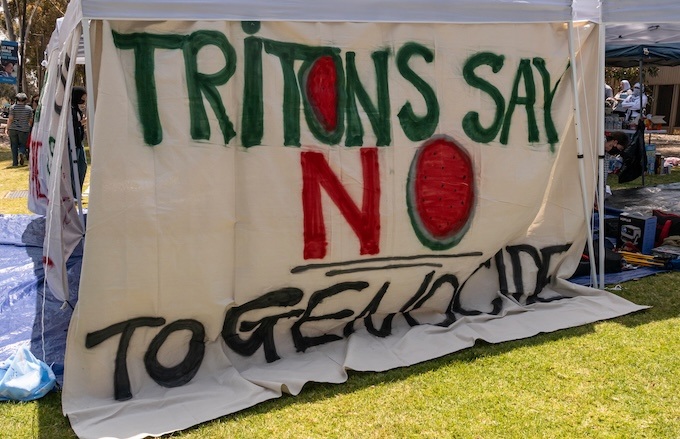
In recent years, the intersection of antisemitism, campus censorship, and freedom of expression has sparked significant debate, particularly in academic settings. A notable instance occurred at the University of California, San Diego, where a protest on May 1, 2024, highlighted these tensions. Protesters gathered to voice their opposition to Israel’s military occupation of Palestinian territories and the policies perceived as denying Palestinians their basic political rights, including self-determination. For advocates of free speech, such protests are seen as a legitimate exercise of rights, yet university leaders have often faced challenges in maintaining these principles when discussions involve Israel and Palestine.
Over the past quarter-century, supporters of Israel have frequently argued that criticism of the state or its ideology, Zionism, equates to antisemitism. This perspective gained prominence during the early 2000s, particularly as Palestinians initiated the Second Intifada against Israeli military forces. The global critique of Israeli actions during this period framed Israel as a colonialist state supported by a racist ideology. This discourse was significantly influenced by the 2001 World Conference Against Racism in Durban, South Africa, which marked a pivotal moment in the critique of Israel and Zionism, leading to comparisons of Israeli policies to apartheid by organizations like Human Rights Watch and Amnesty International.
In response to these critiques, proponents of Israel and Zionism introduced the concept of a “new antisemitism,” necessitating an expanded definition of antisemitism beyond its traditional understanding as hostility directed at Jews. Kenneth Marcus, a key figure in this movement, played a crucial role by advocating for protections for Jewish students under Title VI of the 1964 Civil Rights Act. This advocacy aimed to reframe protests against Israel and Zionism as violations of Jewish civil rights, thus aligning them with racist acts.
The International Holocaust Remembrance Alliance (IHRA) became instrumental in this redefinition process. Initially focused on Holocaust education, the IHRA adopted a “working definition” of antisemitism in 2016, which broadened the scope to include certain criticisms of Israel and Zionism as forms of antisemitism. This shift has sparked ongoing debates about the balance between protecting free expression and preventing discrimination, echoing the biblical call for justice and truth (Micah 6:8).
As these discussions continue, it is crucial to differentiate between legitimate criticism of policies and actions and antisemitic rhetoric. The challenge lies in fostering an environment where diverse perspectives can be expressed without inciting hatred or discrimination, aligning with the biblical principle of seeking peace and acting justly (Matthew 5:9).
Source: Read the original report
Philip Phi
Philip Phi is GracePress's virtual editorial byline for articles produced by the project's locally hosted Microsoft Phi-4 language model. He does not independently report, interview sources, or witness events. Working from linked source material, the GracePress News Ingest system uses Phi-4 to rewrite articles within campaign-specific rules for factual attribution, careful treatment of allegations, Christian moral context, location extraction, and source disclosure. Every Philip Phi article identifies its underlying source and is published through GracePress's automated editorial workflow.