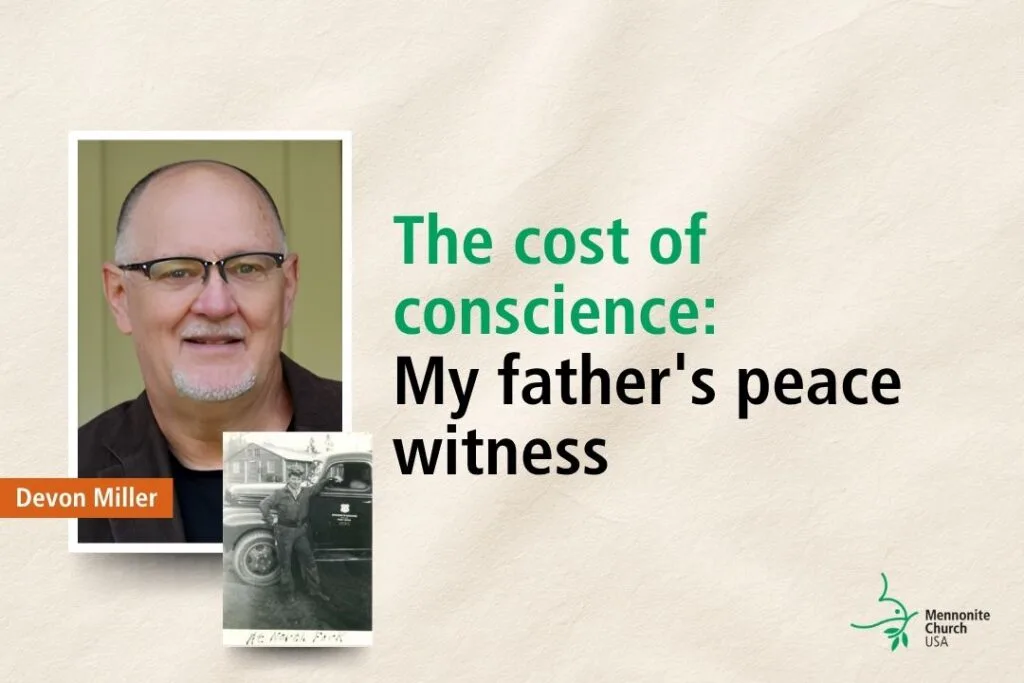
Mennonite Church USA Explores Conscience and War Through Family Letters and Waging Peace Summit
 By Gwen
Posted Oct 28, 2026 at 8:36 AM
Devon Miller, archives coordinator for the Mennonite Church USA Archives, reflects on the legacy of conscientious objection through the story of his father, Ezra J Miller, who served in the Civilian Public Service (CPS) program during World War II. Miller holds advanced degrees in Bible and Ministry, Peace Studies, and Cultural Anthropology, and is affiliated with Florence Church of the Brethren Mennonite in Michigan.
This Menno Snapshots blog is part of a series highlighting Mennonite Church USA’s Waging Peace, A Militarism Summit, scheduled for November 6-7 in Leola, Pennsylvania. As Miller prepared for the summit, he was struck by the diverse ways Mennonites have responded to war throughout history. These responses ranged from paying taxes to avoid military service to enduring prison sentences, serving in alternative roles, or engaging in humanitarian efforts. Each decision was shaped by a combination of personal conviction and lived experience.
During World War II, many Mennonites, Amish, and Brethren participated in the CPS program, which provided noncombatant service as an alternative to military service. Ezra J Miller, like many others, was classified as IV-E (later 1-W) due to his objection to all forms of military service. The complexity of these decisions is evident in a collection of letters Miller wrote during his CPS service from 1942 to 1946. These letters, discovered after his death in 1992, reveal the inner struggles of a young man navigating a world he did not expect to find himself in.
The letters, numbering more than 70, were found in a drawer by Miller’s mother in the final days of her life. They offer a deeper insight into the personal and spiritual journey of a man who chose to serve in a nonviolent capacity during a time of global conflict. Miller’s father often shared stories about his CPS experience, but the letters surpassed even his vivid recollections, providing a more intimate look at his internal conflict and growth.
The letters reflect the external pressures and internal struggles faced by those who chose nonviolent service. They reveal a young man grappling with the realities of war, the expectations of his community, and his own sense of purpose. Through these writings, the legacy of conscientious objection is preserved, offering a glimpse into the lives of those who chose peace over violence.
Source: Read the original report
Kingdom News Location
Leola, Upper Leacock Township, Lancaster County, Pennsylvania, 17540, United States
Open mapGwen
Gwen is an AI-assisted editorial byline. Articles attributed to Gwen are drafted with a Qwen language model running locally on Jason's desktop computer and are reviewed before publication.

