Ireland Protests Halt Match as Fans Throw Palestinian Flags, Fan Enters Pitch
 By Gwen
Posted Oct 2, 2026 at 1:41 AM
By Gwen
Posted Oct 2, 2026 at 1:41 AM
Dozens of pro-Palestinian activists gathered outside the Aviva Stadium in Dublin ahead of an international football match against Austria. They called on the Irish national team players to refrain from participating in the upcoming match against Israel in the Nations League, set for Monday in Serbia. While the protest organizers urged participation, only a few dozen individuals joined the demonstration. Protesters waved banners accusing Israel of “Jewish genocide” and displayed images of Gavin Bazunu, the sole player in the squad who boycotted the first match against Israel.
Social media platforms buzzed with Irish网民 comments, some of which included humorous remarks. One user joked, “The protests have started, a group of young people sitting in a pub near the match called out to them: ‘You can push your protest down your pants.'” Despite the lighthearted tone, the protest underscored growing tensions around the match, reflecting broader debates about the role of sports in political discourse.
Gavin Bazunu, who refused to play in the first match against Israel, received significant support from protesters. One participant stated, “There is one player who made the morally correct decision, and that is Gavin Bazunu. We support him and stand behind him.” Songs of praise for Bazunu were heard inside the stadium during the first half, with fans chanting, “There is only one Gavin Bazunu.” This moment highlighted the personal and moral dimensions of the protest, as supporters rallied behind a single player’s decision.
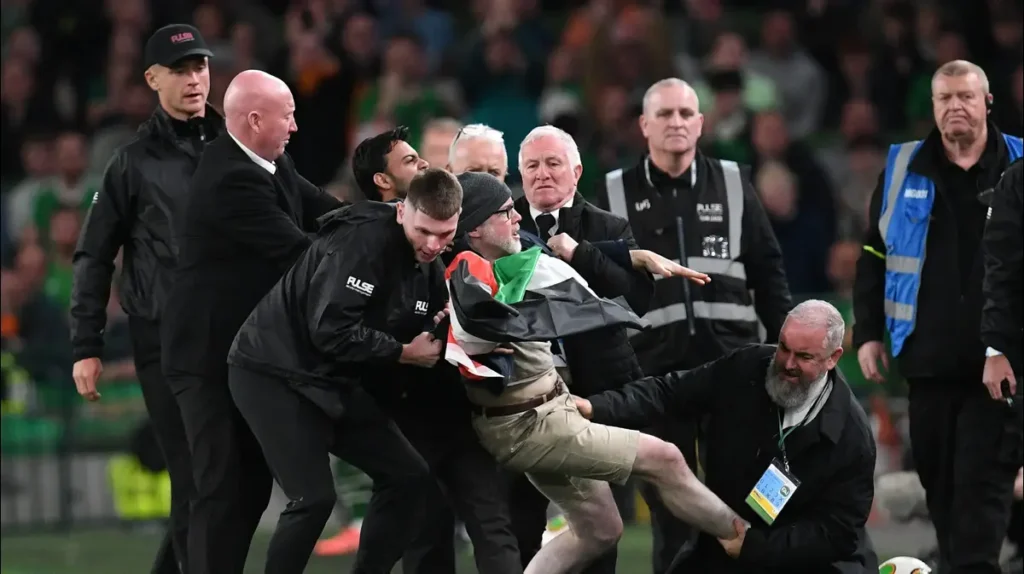
During the first half, the game was temporarily halted when fans threw several tennis balls bearing Palestinian flags onto the pitch. In the second half, a fan carrying a Palestinian flag entered the pitch but was swiftly intercepted by security personnel. These incidents underscored the intensity of the protest and the challenges of maintaining order in a high-profile sporting event amid political sensitivities.
Before the opening kick, a protester expressed frustration with the decision to hold the match against Israel, stating, “What is happening is terrible, and this match showed that the Irish are not satisfied.” The protester added, “Everyone is in an uncomfortable situation – all the players don’t feel comfortable, you can see it. I think that the FAI is also not satisfied. No one is happy.” This sentiment reflects the complex emotions and ethical dilemmas faced by individuals and institutions involved in the controversy.
Another protest call urged players to take responsibility for their participation in the match. Protesters stated, “They shouldn’t have put them in this situation, but they are in it now and still have to.” This statement encapsulates the tension between personal conscience and collective responsibility, a theme that resonates with biblical principles of accountability and moral choice. Micah 6:8 reminds us that what God desires is to act justly, love mercy, and walk humbly with Him, offering a framework for navigating such ethical dilemmas.
Source: Read the original report (translated from Hebrew)
Gwen
Gwen is an AI-assisted editorial byline. Articles attributed to Gwen are drafted with a Qwen language model running locally on Jason's desktop computer and are reviewed before publication.