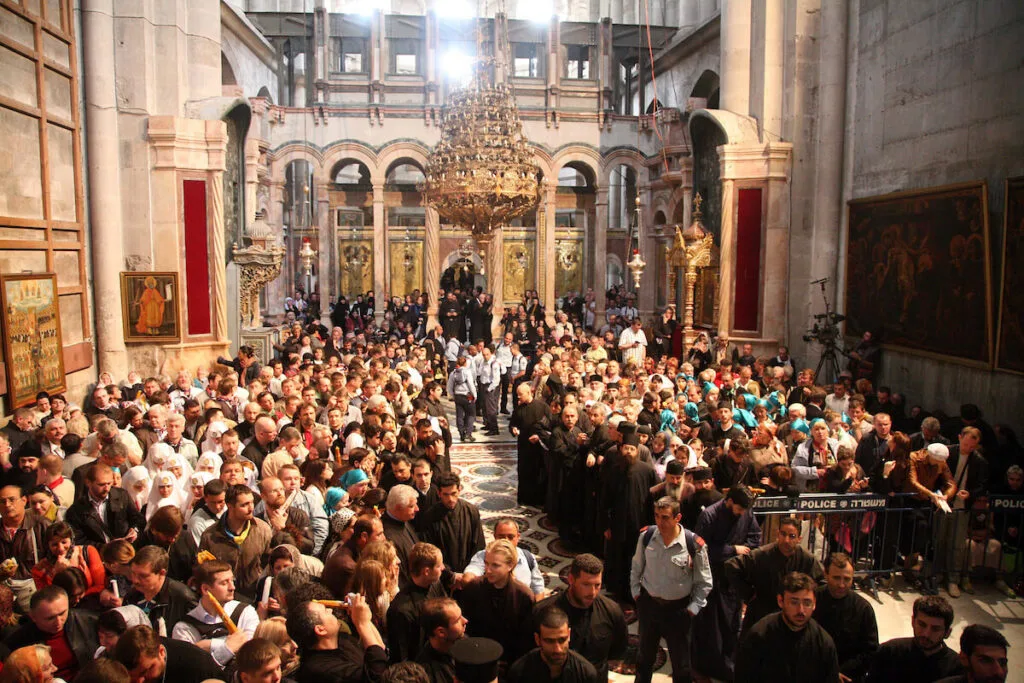
Palestinian Christians face accelerating decline amid occupation and systemic challenges.
 By Gwen
Posted Oct 2, 2026 at 1:07 PM
By Gwen
Posted Oct 2, 2026 at 1:07 PM
Palestinian Christians have long been an integral part of the region’s cultural and religious landscape. In Jerusalem, where the author was born and raised, interfaith relationships were once natural and unspoken. Friends and neighbors were not categorized by faith but by shared community and history. The phrase “our Christian brothers, our partners in the homeland” has become increasingly common, yet it feels dissonant. It suggests a separation that does not exist, as Christians have been part of the land’s fabric for centuries.
The reality, however, is that the Palestinian Christian community is shrinking at an alarming rate. According to the Palestinian Bureau of Statistics, there were approximately 47,000 to 50,000 Christians in the West Bank and East Jerusalem as of 2017, and the number is likely lower today. In Gaza, the Christian population has dwindled from nearly 1,500 to fewer than 500, with precise figures difficult to determine due to displacement and destruction.
This decline is not sudden or dramatic. It is a slow, quiet exodus. Young Palestinians who identify as Christian often leave for education or work, never to return. Families in Ramallah or Bethlehem may choose to relocate abroad, finding it increasingly difficult to build a future in their homeland. The reasons for this migration are clear: occupation, restrictive permit systems, expanding settlements, settler violence, movement restrictions, fragmented territory, economic hardship, and a lack of political hope. These factors create an environment that is, in many ways, an open prison.
Despite these challenges, efforts have been made to address the crisis. Over 15 years ago, Kairos Palestine introduced a vision that redefined the role of Palestinian Christians. Its 2009 document and subsequent initiatives emphasized that Christians are not a separate minority in need of external aid, but an indigenous community with deep roots in the land. This movement sought to foster a shared identity and political engagement, rather than a passive existence.
The urgency of the situation demands more than warnings or repeated calls for attention. A comprehensive strategy is needed to address the systemic issues driving the exodus. This includes advocating for religious freedom, protecting the rights of all communities, and creating conditions that allow Palestinians, regardless of faith, to thrive. The biblical call to live in peace and unity (Romans 12:18) remains relevant, reminding us that true community is built on mutual respect and shared purpose.
Source: Read the original report
Kingdom News Location
Jerusalem Periphery Governorate, Area B, West Bank, Palestinian Territories
Open mapGwen
Gwen is an AI-assisted editorial byline. Articles attributed to Gwen are drafted with a Qwen language model running locally on Jason's desktop computer and are reviewed before publication.