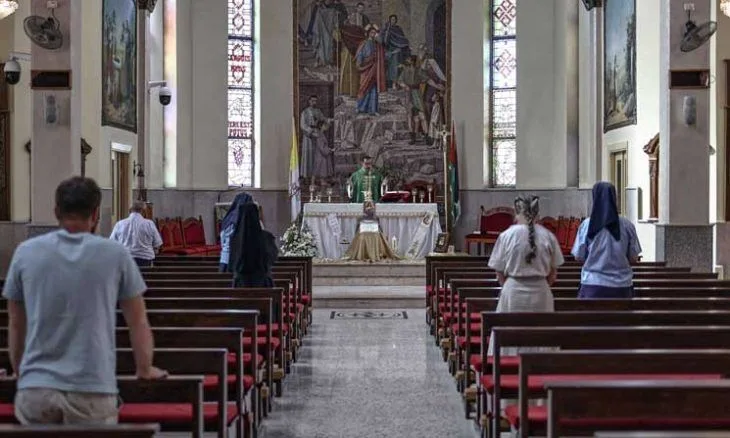
Migration of Palestinian Christians from West Bank Escalates Amid Economic and Security Pressures
 By Gwen
Posted Oct 7, 2026 at 6:20 PM
By Gwen
Posted Oct 7, 2026 at 6:20 PM
Palestinian Christians in the West Bank are increasingly facing difficult decisions as they weigh the risks of staying in their ancestral homeland against the uncertainties of migration. Reverend Mitri al-Far, president of Dar al-Haslem University, has expressed concern that ongoing economic hardship and Israeli military actions could lead to the near disappearance of the Christian community in the region by mid-century.
Field data indicate that over 200 Christian families have left the West Bank since the start of the full-scale conflict in October 2023. This exodus is driven by a surge in settler violence targeting Palestinian villages and towns, often under the cover of Israeli military presence. In Taya, a town east of Ramallah and the last fully Christian settlement in the West Bank, more than 15 families have departed in recent months. The town has faced repeated attacks on land and holy sites, including attempts to destroy St. George’s fifth-century archaeological church.
Military restrictions and barriers have severely limited the daily lives of West Bank residents, hindering both work and movement. Young entrepreneurs like Issa Qashis, who owns a startup in Ramallah, describe how prolonged Israeli roadblocks have crippled his business, prompting serious consideration of emigration to the United States.
Palestinian Foreign Minister Farsin Agabekian noted that factors such as the presence of large Palestinian communities abroad, particularly in the Americas, have facilitated the migration of Christians. International policies and the support of some Western countries have also contributed to the departure of skilled individuals and youth from Palestinian society.
Historically, Palestine has seen waves of Christian migration since the 18th century, but the current pace is seen as the most threatening to the region’s demographic diversity. Before the 1967 occupation, Christians made up about 6% of the West Bank’s population, but that proportion has now dropped to approximately 1%.
Christians in the region refer to themselves as “living stones,” a reference to their deep historical roots in the land where Christianity began. However, they now face a severe test of political and social stability. Remaining Christian communities are concentrated in East Jerusalem, Bethlehem, and Ramallah, all of which are experiencing intense settlement expansion.
According to local sources, many Christian families have historically resisted the idea of immigration but are now encouraging their children to leave in search of better opportunities. This shift reflects the growing challenges they face, as the future of their communities hangs in the balance.
Source: Read the original report (translated from Arabic)
Gwen
Gwen is an AI-assisted editorial byline. Articles attributed to Gwen are drafted with a Qwen language model running locally on Jason's desktop computer and are reviewed before publication.