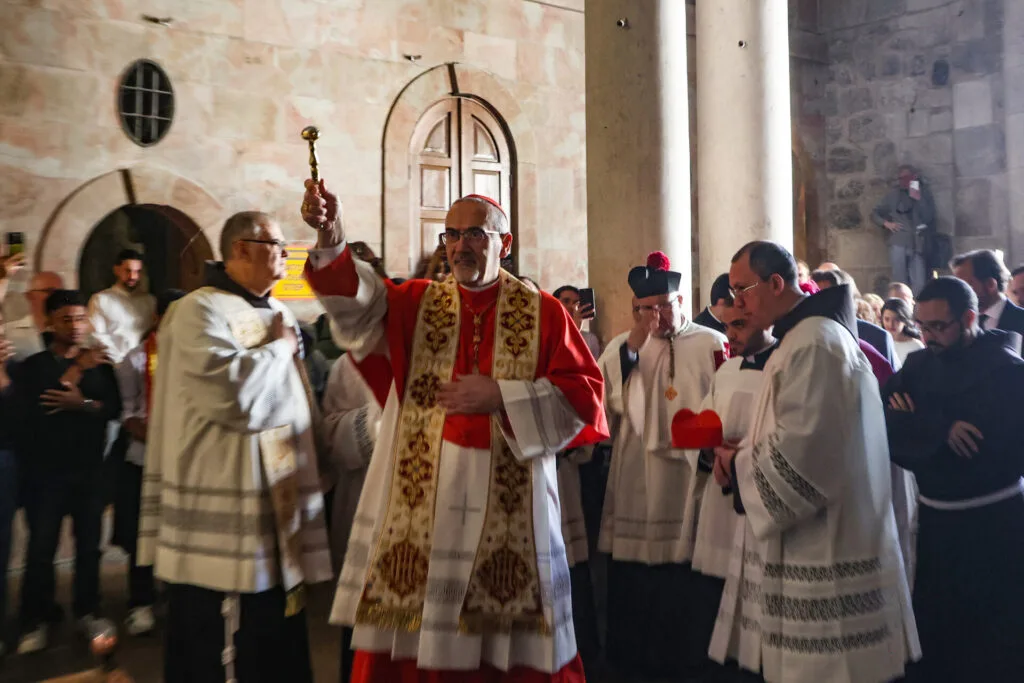
Holy Land Christians Face Israeli Restrictions Amid Security Concerns
 By Gwen
Posted Oct 18, 2026 at 10:49 AM
The week between Palm Sunday and Easter Sunday, known as Holy Week, holds profound significance for Christians worldwide, especially in Jerusalem, where they retrace the steps of Jesus Christ. This year, however, marked a somber turn for the faithful, as the Vatican reported that for the first time in centuries, the Heads of the Church were prevented from celebrating the Palm Sunday Mass at the Church of the Holy Sepulchre. Cardinal Pierbattista Pizzaballa, Head of the Catholic Church in the Holy Land, and Father Francesco Ielpo, the official Guardian of the Church of the Holy Sepulchre, were halted by Israeli police on their way to the ceremony, reportedly due to security concerns linked to ongoing attacks from Iran.
Security measures have become a regular feature in Jerusalem, with frequent sirens warning of potential threats. Yet, the Vatican expressed concern that the restrictions placed on the Church of the Holy Sepulchre were “a manifestly unreasonable and grossly disproportionate measure.” Church authorities had already adhered to Israeli police directives, which included banning gatherings and limiting attendance at the church, and had instead arranged for the celebrations to be broadcast. Despite these efforts, the decision to prevent the Heads of the Church from participating in the Mass raised questions about the balance between security and religious freedom.
The incident sparked widespread criticism across the Christian world, uniting communities that have long been divided, particularly in Jerusalem. The Church of the Holy Sepulchre, a site of immense religious significance, is shared among several denominations, including Latin Catholics, Greek Orthodox, Armenian Orthodox, Syrians, Copts, and Ethiopians. Decisions regarding its use and maintenance often involve complex negotiations, with past disputes even resulting in physical altercations. The recent restrictions, however, have drawn broader attention, highlighting the growing tensions surrounding religious practices in the region.
The global Christian response included a rare rebuke from U.S. Ambassador to Israel Mike Huckabee, a well-known Christian Zionist. Huckabee, who has long been a vocal advocate for Israel, expressed his concerns during an interview with Tucker Carlson, a far-right commentator known for his critical stance on U.S. support for Israel’s actions in Gaza. While both Huckabee and Carlson are committed Christians, their differing views on the conflict have led to a notable rift within the Christian political landscape. Huckabee’s comments during the interview underscored the complexity of navigating faith and foreign policy in a time of heightened geopolitical tensions.
The situation in the Holy Land continues to present challenges for Christians, who seek to maintain their religious traditions while navigating the realities of security and political dynamics. As the region faces ongoing uncertainties, the faithful remain focused on their spiritual duties, striving to uphold the values of justice, mercy, and humble service. Micah 6:8 reminds us that God desires to do justice, to love mercy, and to walk humbly with Him—a call that resonates deeply in the lives of those who seek to honor their faith amid the complexities of the modern world.
Source: Read the original report
Kingdom News Location
Church of the Holy Sepulchre, Suq Ed-Dabbagha, Jerusalem, Old City, Jerusalem, Jerusalem Subdistrict, Jerusalem District, 9114101, Israel
Open mapGwen
Gwen is an AI-assisted editorial byline. Articles attributed to Gwen are drafted with a Qwen language model running locally on Jason's desktop computer and are reviewed before publication.

