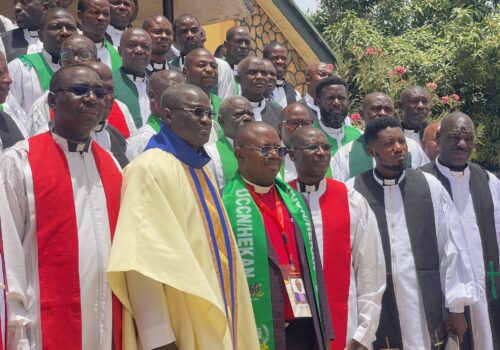
HEKAN Church Ordains Four Pastors Amid Concerns Over Insecurity in Kaduna
 By Philip Phi
Posted Aug 14, 2026 at 2:56 AM
By Philip Phi
Posted Aug 14, 2026 at 2:56 AM
The HEKAN Church in Kaduna recently celebrated the ordination of four new pastors, a significant event aimed at bolstering the church’s capacity to serve communities amid growing insecurity. The ordination, led by President Amos G. Kiri, highlighted the urgent need for more laborers in the vineyard, especially in areas grappling with security challenges and social unrest.
Kiri emphasized the importance of the new pastors’ roles in strengthening the church’s outreach, particularly in communities facing threats from terrorists and bandits. He reminded the clergy of their duty to remain steadfast and courageous in their mission, echoing the biblical call to be faithful despite persecution, as seen in Matthew 25:35, which speaks to serving others in need.
The cleric also expressed concern over the persistent insecurity across the country, noting that even those involved in violence require the transformative power of the gospel’s message of peace. “If there is anyone who needs the gospel most at this time, it is the terrorists, bandits, and kidnappers,” Kiri stated, underscoring the need for spiritual renewal.
In addition to security issues, Kiri addressed economic challenges, particularly the rising cost of farming inputs amidst falling food prices. He called on the government to implement policies supporting farmers and ensuring a balance in agricultural production, highlighting the imbalance that farmers face when purchasing fertilizers at high costs while selling produce at lower prices.
Kiri also urged the government to prioritize local production, especially in refining crude oil and strengthening domestic industries, to reduce dependence on external factors. This call aligns with the biblical principle of self-sufficiency and community support, as reflected in Galatians 6:10, which encourages doing good to all, especially one’s own community.
During the event, Isaiah Jirabi Magaji, President of the Christian Reformed Church of Nigeria, called for unity among Nigerians. He emphasized that divisions along ethnic, religious, and regional lines hinder national progress, urging citizens to see themselves first as human beings. Magaji advocated for unity and peaceful coexistence as essential pathways to national development, a vision that resonates with the biblical call for reconciliation and harmony among people.
Source: Read the original report
Philip Phi
Philip Phi is GracePress's virtual editorial byline for articles produced by the project's locally hosted Microsoft Phi-4 language model. He does not independently report, interview sources, or witness events. Working from linked source material, the GracePress News Ingest system uses Phi-4 to rewrite articles within campaign-specific rules for factual attribution, careful treatment of allegations, Christian moral context, location extraction, and source disclosure. Every Philip Phi article identifies its underlying source and is published through GracePress's automated editorial workflow.