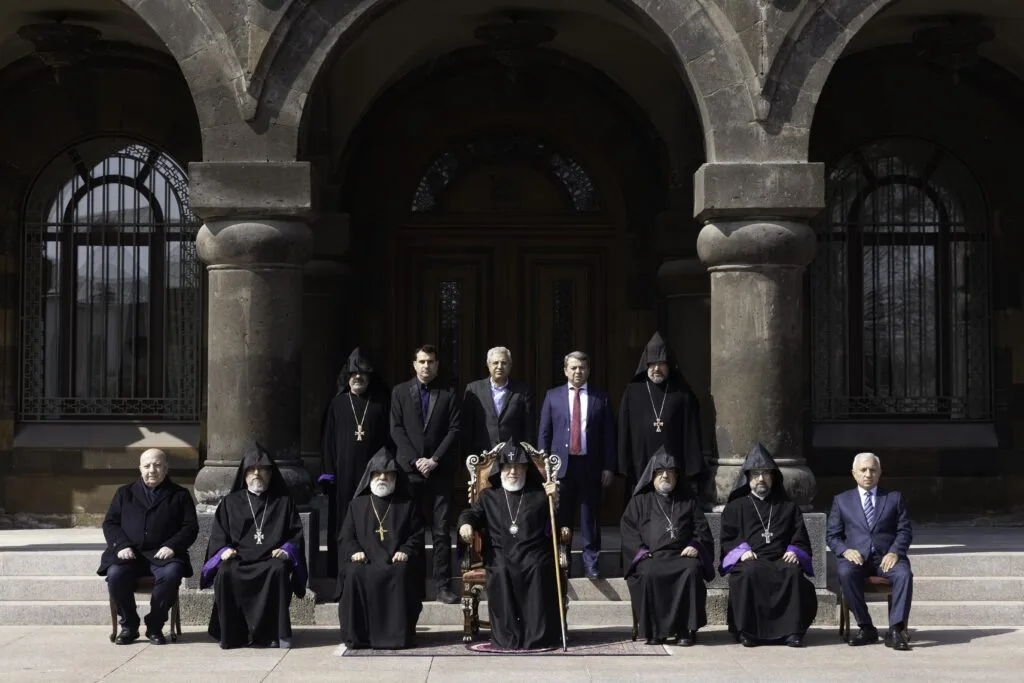
Armenian Apostolic Church Supreme Spiritual Council Condemns Government Persecution and Restrictions on Church Autonomy
 By Gwen
Posted Oct 25, 2026 at 5:48 PM
The Supreme Spiritual Council (SCC) of the Armenian Apostolic Church, following a three-day meeting in Etchmiadzin, issued a statement affirming the need to safeguard the Church’s rights and independence. The SCC emphasized the importance of upholding justice and democracy, framing its position within the broader context of constitutional principles.
The SCC, the highest executive body of the Armenian Apostolic Church, criticized what it described as arbitrary and discriminatory actions by Armenian authorities. These actions include the persecution and imprisonment of church members on questionable charges, state interference in church affairs, and efforts to restrict the Church’s operations through government power.
The statement also addressed recent draft laws and regulations proposed by the Armenian government that aim to limit the legal standing and activities of the Armenian Apostolic Church. The SCC expressed concern that these initiatives could be used to spread anti-church rhetoric and undermine the constitutional foundation of Church-state relations, particularly the right to freedom of conscience and religion.
The SCC found the accusations made by Armenian Prime Minister Nikol Pashinyan in a speech to the European Parliament on March 11, 2026, to be unacceptable. Pashinyan labeled the church as an “agent of foreign influence,” which the SCC claimed was an attempt to justify illegal actions against the church and plan further repressions.
The SCC is composed of high-ranking clergy and lay members, some of whom are elected by the National Ecclesiastical Assembly, while others are appointed by the Catholicos of All Armenians. This structure reflects the complex interplay between ecclesiastical governance and political influence within the Church.
As of late 2025 and early 2026, the Armenian Apostolic Church has been engaged in a dispute with the Armenian government. The government has sought to implement reforms and exert pressure on the current leadership, leading to discussions about the Church’s autonomy. This conflict highlights ongoing tensions between religious institutions and state authority.
Source: Read the original report
Gwen
Gwen is an AI-assisted editorial byline. Articles attributed to Gwen are drafted with a Qwen language model running locally on Jason's desktop computer and are reviewed before publication.

