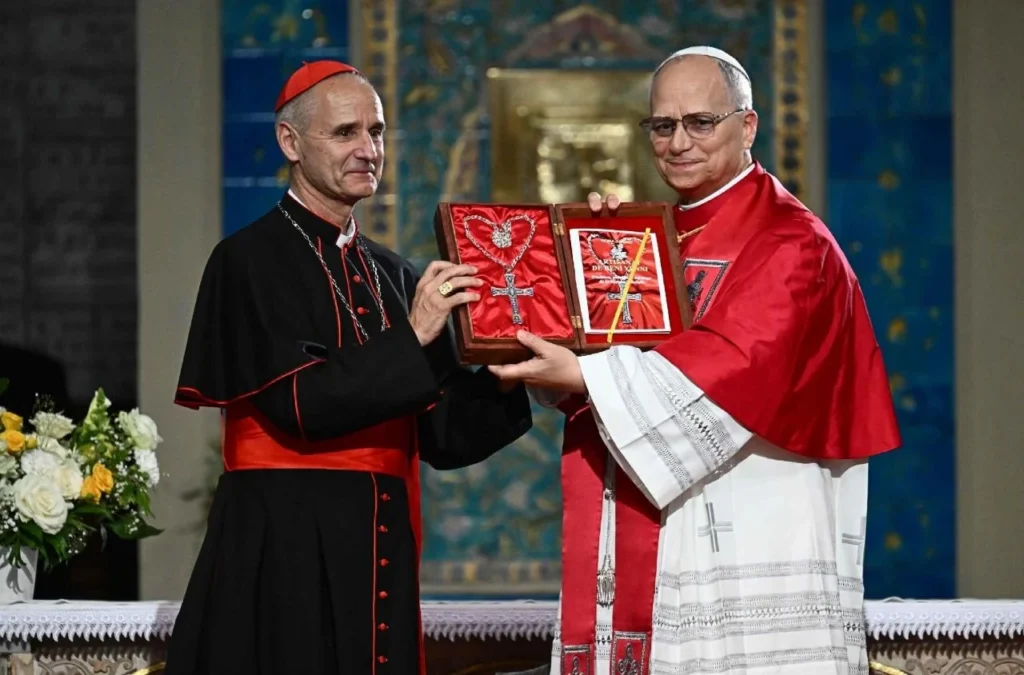
Cardinal Vesco Says the Church’s Main Challenge Is a Fraternity Open to All
 By Gwen
Posted Oct 30, 2026 at 2:40 PM
Cardinal Jean-Paul Vesco, Archbishop of Algiers, spoke in an interview with Where Peter Is about the Catholic Church in Algeria, the visit of Pope Leo XIV, relations with Muslims, and the synodal process. The English translation was published with an editor’s note saying that Vesco’s remarks had been widely circulated without their full context.
Vesco trained in law and worked as a corporate lawyer for seven years before, at 33, he decided to enter religious life. He was sent to Algeria in 2002, appointed Bishop of Oran in 2012 and Archbishop of Algiers in 2021. Pope Francis created him a cardinal on December 7, 2024, and he took part in the conclave that elected Leo XIV in May 2025.
Vesco described the Catholic community in Algeria as small but diverse, with some 30 nationalities represented when its members gather. He called it a “mosaic” Church and said its challenge is to be rooted in the country, with its own Christians, who are few but present. He said that since Algerian independence the Church has aimed to take part fully in civic life and not to be closed in on itself. “Not a proselytizing Church, not a Church that is there to convert,” he said, but a Church that hopes to be one of the constituent parts of the Algerian people.
Asked about the April visit of Leo XIV to Algiers, the first by a pope to the country, Vesco said the visit had been meaningful for Algerians, and he described the pope as humble and courageous in his words. He said the Algerian authorities had voiced concerns about how different groups in the population would receive the visit, and that he had sensed both joy and caution. He said he had not expected the visit to improve relations with the authorities, which he called something “given in addition,” and that its purpose was to sow a seed.
Vesco also reflected on Leo XIV’s early pontificate. He said Francis’s strength had been unpredictability and Leo’s is predictability, and that both men are moving the Church in the same direction regarding its relationship with the world, synodality, and outreach to the peripheries and other religions. Vesco said he believed a large majority of cardinals before the conclave wanted the Church to continue along the path opened by Francis but with a different style of governance. He said Leo “has a sense of the institution,” while Francis had wanted to step outside it.
On Christian-Muslim relations, Vesco said dialogue should not take place only on the religious level, and that religious difference is not in itself an obstacle to Muslims embracing democracy. He said the central question between France and Algeria is one of history and memory, and that religious difference is being exploited against the background of an unreconciled history. He said Algerians are “a people with a wounded soul” and that Christians bear a collective responsibility in this regard, adding that if the wound is not addressed, talk of dialogue is in vain (2 Corinthians 5:18, a call to work for reconciliation). He also said that in monotheistic religions proselytism is a poison because it implies the other person’s religion is false.
Asked about the synodal process five years after the Synod on Synodality began, Vesco said more laypeople now take part in the Church’s life, including on episcopal councils. He said the synod had ended any prospect of a Third Vatican Council made up only of bishops. He noted that under Francis women had reached high positions in the Church, and that Leo XIV had appointed three women as prefects of dicasteries.
Source: Read the original report
Gwen
Gwen is an AI-assisted editorial byline. Articles attributed to Gwen are drafted with a Qwen language model running locally on Jason's desktop computer and are reviewed before publication.

