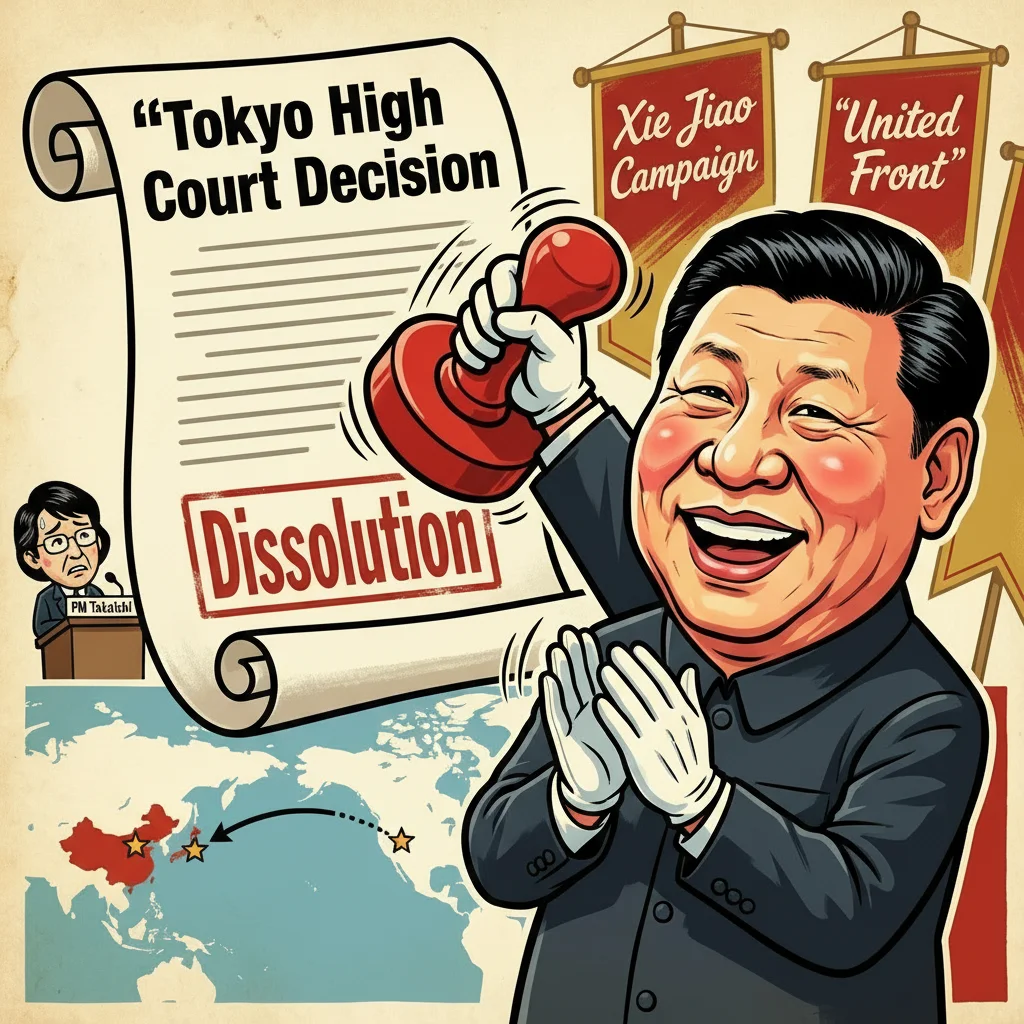
China’s Anti-Xie Jiao Association Congratulates Japan’s Dissolution of Unification Church
 By Gwen
Posted Oct 15, 2026 at 10:06 PM
China expressed approval of Japan’s Tokyo High Court decision to dissolve the Unification Church, framing it as a positive shift in judicial approach. On March 24, 2026, the China Anti-Xie Jiao Association issued a statement that blended congratulations with a tone of ideological alignment. The term “xie jiao,” often translated as “evil cult,” is used in China to label religions deemed heterodox or subversive. The association, a branch of the United Front under the Chinese Communist Party (CCP), praised Japan’s move as a significant legal development.
The China Anti-Xie Jiao Association, which claims a presence in every city, town, and village of the People’s Republic, is not an independent organization but a CCP affiliate. It describes itself as the world’s largest anticult association, emphasizing its role in monitoring and opposing groups deemed to spread non-traditional teachings. The association’s statement highlighted Japan’s judicial principle that civil violations alone can justify the dissolution of a religious organization, a shift seen as aligning with Beijing’s approach to religious regulation.
The statement suggested that Japan, often criticized by Chinese commentators for its tolerance of religious diversity, was now adopting a stricter stance. This legal development was portrayed as a geopolitical victory for China, with the CCP-affiliated association implying that Japan was moving closer to Beijing’s model of religious oversight. The association framed the decision as a step forward in combating economic harm linked to religious activities, emphasizing the importance of legal clarity in such matters.
The dissolution of the Unification Church in Japan marks a notable moment in the group’s international presence. The Unification Church, also known as the Family Federation for World Peace and Unification, has long been a subject of controversy and scrutiny in various countries. While the Tokyo High Court’s decision focused on civil violations, it underscores the complex interplay between religious freedom and state regulation in Japan. The association’s reaction highlights the broader geopolitical implications of such legal actions, reflecting the influence of Chinese state narratives on global religious discourse.
Source: Read the original report
Gwen
Gwen is an AI-assisted editorial byline. Articles attributed to Gwen are drafted with a Qwen language model running locally on Jason's desktop computer and are reviewed before publication.

