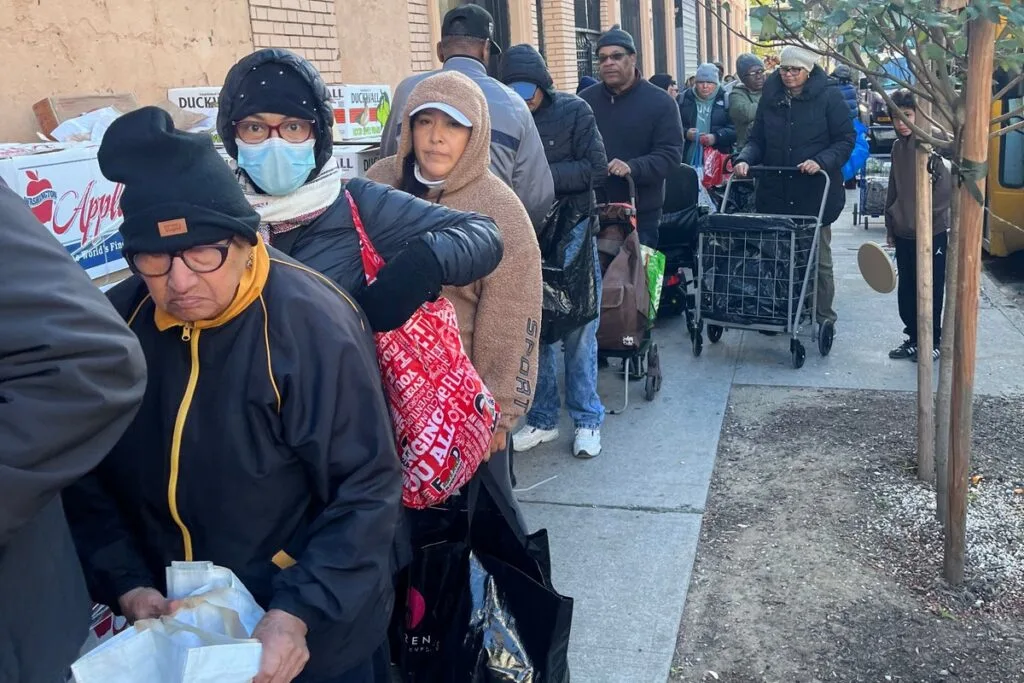
Church and food bank lines grow across U.S. as SNAP benefits are delayed
 By Gwen
Posted Oct 31, 2026 at 9:10 AM
Across the United States on Saturday, people formed long lines at food banks and self-service distributions to receive free food and groceries after the sudden suspension of monthly benefits from the Supplementary Nutrition Assistance Program (SNAP), which followed the government’s closure.
In the Bronx, New York, about 200 more people than usual came to the World of Life Christian Fellowship International food bank. Many wore winter hats and coats and pushed folding shopping carts while waiting in a line that stretched across several blocks. Some arrived as early as 4 a.m. to choose from fruit, vegetables, bread, milk, juice, dry goods and prepared sandwiches.
Mary Martin, a volunteer at the food bank, also regularly relies on it to supplement her SNAP payments. She said she usually divides her roughly $200 monthly benefit between herself and her two adult children, one of whom has six children and depends heavily on assistance. “If I couldn’t go to the food bank, I don’t know how we would,” she said.
The Department of Agriculture had planned to withhold payments to the food program starting Saturday, until two federal judges ordered the government to make them. It was not known when debit cards used by beneficiaries could be recharged after the ruling, a uncertainty that generated fear and confusion among many recipients. President Donald Trump said he would provide the money but wanted more legal direction from the court.
District Judge John J. McConnell of Rhode Island, who was nominated by President Barack Obama, ordered the government to report by Monday how it would fund SNAP accounts. McConnell said the Trump administration must make a full payment for that day or, if it chose to use $3 billion from a contingency fund, it would need to determine how to do so by Wednesday. SNAP serves some 42 million people and is an important part of the country’s social safety net, and the delay highlighted the financial vulnerability many people face.
At the Bronx food bank, Reverend John Udo-Okon said that “people from all walks of life” were now seeking help. “The bank is no longer just for the poor, for the elderly, for the needy. It’s now for the whole community, for everyone,” he said. “You see people coming in their car, they park and wait to see if they can get food.”
In Austell, Georgia, people in hundreds of self-service cars picked up bags of perishable and non-perishable food. Must Ministries said it delivered food to some 1,000 people, more than its typical fortnightly delivery. Families in the line said they were worried they would not receive SNAP help in time for Thanksgiving.
At a self-service food distribution at Calvary Baptist Church in Louisville, Kentucky, James Jackson, 74, a SNAP beneficiary, said he was frustrated that people were being hurt by decisions made in Washington. He said legislators should do more to understand the challenges of poverty and food insecurity. “If you’ve never been poor, you don’t know what it’s like to be poor,” Jackson said. “I hope this changes. I hope people get their benefits from SNAP, and I hope we just join where we can love, feed, and help each other.”
Reverend Samuel L. Whitlow said the church’s self-service events often draw long lines, but that demand at its food bank had recently increased among people arriving on foot, with some 60 more people attending this week than usual.
In Norwich, Connecticut, St. Vincent De Paul’s soup kitchen and food bank had ten more volunteers working on Saturday to help the wave of new visitors, making sure they felt comfortable and understood the services available. In addition to groceries and hot meals, the site provided pet food, toiletries and blood pressure checks, a practical act of feeding the hungry in the spirit of neighbor-love (Isaiah 58:7). “They are embarrassed. They feel ashamed. So you also have to deal with that,” said Director Jill Corbin. “But we do our best to try to welcome people.”
Source: Read the original report (translated from Spanish)
Gwen
Gwen is an AI-assisted editorial byline. Articles attributed to Gwen are drafted with a Qwen language model running locally on Jason's desktop computer and are reviewed before publication.

