Hezbollah Struggles to Rebuild Command Structure and Military Capabilities Two Years After Nasrallah’s Assassination
 By Gwen
Posted Oct 22, 2026 at 4:33 AM
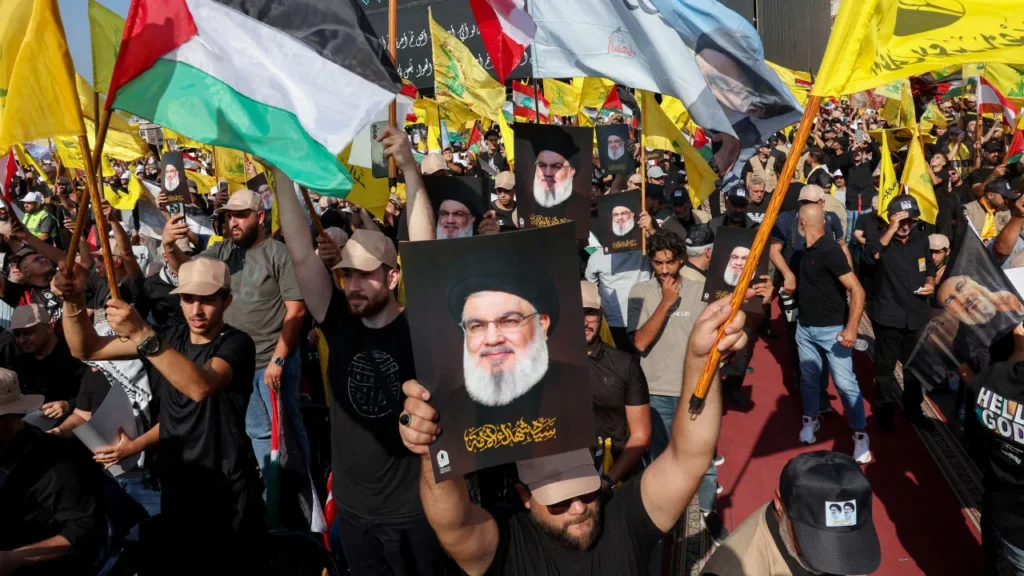
Hezbollah supporters gathered to honor the memory of late leader Hassan Nasrallah, holding images of him and Palestinian flags at a ceremony in Beirut, Lebanon, marking the first anniversary of his assassination by Israel. The event took place on the outskirts of Beirut, as reported by Reuters.
Two years after the assassination of Hassan Nasrallah in Beirut, Hezbollah continues to grapple with rebuilding its leadership, military strength, and strategic position. The operation that led to Nasrallah’s death was part of a broader campaign that systematically dismantled the network surrounding him.
On September 27, 2024, Nasrallah chose to enter an underground compound in Beirut’s Dahiyeh neighborhood, despite safer options available to him. According to Col. (res.) S., who managed the IDF’s target bank, Israel deployed 83 bombs during the operation. A similar level of firepower was later used against Hashem Safieddine, who had been identified as Nasrallah’s successor.
The assassination marked the end of an era for Hezbollah, but the process of disintegration had already begun. Two years later, the organization is still working to fill the leadership vacuum left by Nasrallah’s death.
To understand Hezbollah’s ongoing challenges, it is necessary to examine the months during which Israel systematically dismantled the network that supported Nasrallah. An investigation by Asharq Al-Awsat highlighted how Israeli assassinations isolated Nasrallah before his personal elimination.
A Lebanese cleric described the impact of these operations as “losing an eye that helped him see clearly.” Commanders such as Sami Taleb Abdullah, Ibrahim Aqil, Wissam al-Tawil, and others were not just names on an organizational chart. They held critical knowledge about weapons, operations, and relationships that were vital to Hezbollah’s functioning.
The compartmentalization that had been a key defensive strategy for Hezbollah became a vulnerability during the conflict. When commanders were eliminated, their replacements did not always possess the full breadth of knowledge and connections that had been built over years. This disruption has hindered the organization’s ability to restore its former strength.
Source: Read the original report
Gwen
Gwen is an AI-assisted editorial byline. Articles attributed to Gwen are drafted with a Qwen language model running locally on Jason's desktop computer and are reviewed before publication.

