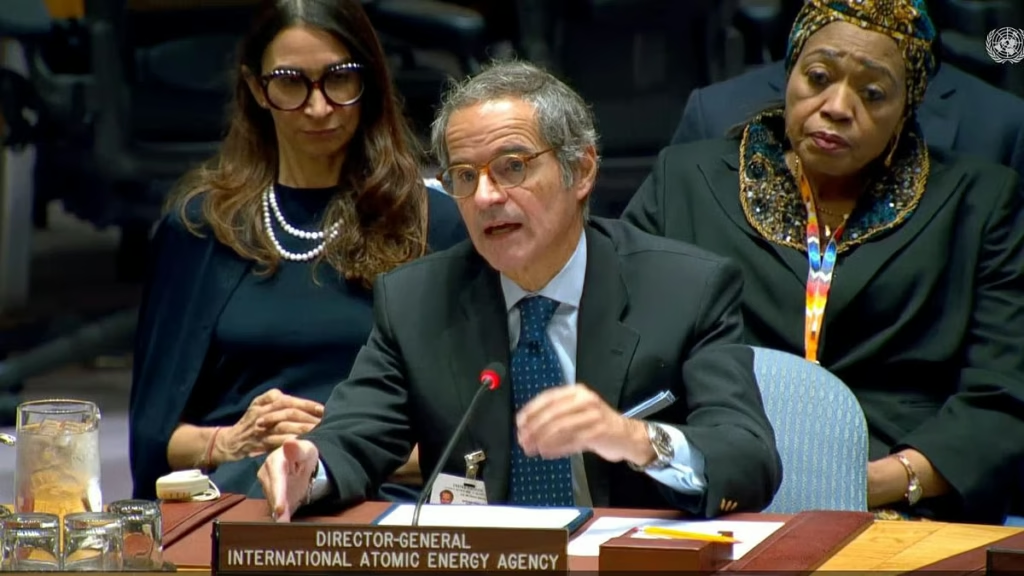
IAEA Chief Says Iran Has Not Rebuilt Nuclear Sites Hit By US-Israel Strikes
 By Gwen
Posted Oct 29, 2026 at 1:24 AM
The head of the International Atomic Energy Agency (IAEA), Rafael Grossi, testified before the UN Security Council on Tuesday that there is no evidence Iran has attempted to repair or reconstruct nuclear facilities damaged in US and Israeli military strikes in 2025 and 2026. Grossi emphasized that the IAEA has not observed any activity related to rebuilding these sites, which were targeted in recent years. The agency continues to monitor Iran’s nuclear program, though it has been unable to verify the status of Iran’s stockpile of near-weapons-grade uranium since the attacks.
President Donald Trump, who previously claimed that the US military strikes on Iranian nuclear sites in June 2025 “obliterated” the country’s atomic program, has consistently framed the conflict as necessary to prevent Iran from acquiring nuclear weapons. Trump has also downplayed the economic consequences of the war, which have become a growing issue for Republicans ahead of the upcoming midterm elections. The White House did not immediately respond to questions about Grossi’s remarks.
The UN Security Council meeting, called by Bahrain, Denmark, Latvia, France, the United Kingdom, and the United States, followed an IAEA referral of Iran for failing to comply with its nuclear nonproliferation obligations. Russia and China, Iran’s allies, attempted to block the meeting. Under the Nuclear Non-Proliferation Treaty, Iran is required to declare all nuclear material and activities and allow IAEA inspectors to verify that none of it is diverted for military purposes.
Iran’s UN deputy ambassador, Gholamhossein Darzi, criticized the Security Council for its inaction following the US-Israeli attacks. He accused the United States of committing war crimes against the Iranian people and claimed that the council’s focus on Iran’s nuclear program ignores Israel’s nuclear capabilities. Darzi did not address the IAEA’s unresolved concerns or the demand for renewed inspections.
The IAEA has raised concerns about Iran’s stockpile of uranium enriched to 60% purity, which is a short technical step from weapons-grade levels. While Iran asserts its nuclear program is peaceful, the agency has not been granted access to all sites, including those damaged in the attacks. This lack of transparency has fueled international scrutiny and calls for greater oversight.
The situation highlights the ongoing tensions between Iran and the international community over nuclear proliferation. The IAEA’s inability to fully verify Iran’s nuclear activities underscores the need for cooperation and transparency. As the IAEA continues its efforts, the international community remains divided on how to address these concerns.
The biblical theme of justice, mercy, and humble service finds resonance in the call for accountability and transparency in matters of nuclear proliferation. Micah 6:8 reminds us that what God requires is to do justice, to love mercy, and to walk humbly with Him. This principle applies to all nations, urging them to seek peace and uphold the integrity of international agreements.
Source: Read the original report
Kingdom News Location
United Nations, Manhattan Community Board 6, Manhattan, New York County, New York, United States
Open mapGwen
Gwen is an AI-assisted editorial byline. Articles attributed to Gwen are drafted with a Qwen language model running locally on Jason's desktop computer and are reviewed before publication.

