Lawsuit Challenging Trump’s Executive Order on Race-Centered Ideology Dismissed by Court
 By Philip Phi
Posted Sep 15, 2026 at 7:56 AM
By Philip Phi
Posted Sep 15, 2026 at 7:56 AM
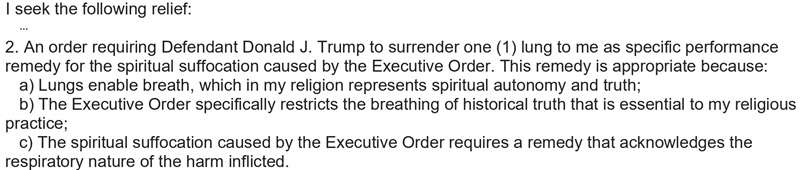
In a recent legal development, a lawsuit challenging President Trump’s Executive Order 14253, titled “Restoring Truth and Sanity to American History,” was dismissed by Magistrate Judge Daphne Oberg. The case, Jeanpierre v. Trump, was initiated by Mr. Jeanpierre, founder of the Black Flag, a tax-exempt religious organization. Mr. Jeanpierre argued that the executive order violated his religious freedoms under the First Amendment and the Religious Freedom Restoration Act (RFRA), as well as Article 18 of the United Nations’ Universal Declaration of Human Rights.
The Black Flag, which prohibits prejudice and discrimination based on various social categories, mandates recognition of systemic racism and inequity and requires active engagement in dismantling systems of oppression. Mr. Jeanpierre claimed that Executive Order 14253, issued on March 27, 2025, opposes narratives that portray American history as inherently racist or oppressive. The order directs federal agencies to remove “divisive race-centered ideology” from institutions like the Smithsonian and to restore monuments altered to reflect a negative view of American history.
Mr. Jeanpierre contended that the executive order establishes a state-sponsored doctrine of American historical exceptionalism, which he viewed as a direct attack on the foundational tenets of his religious beliefs. The order aims to prohibit exhibits or programs that degrade shared American values or promote ideologies inconsistent with federal law, targeting changes made to historical presentations since January 1, 2020. It also directs the Department of the Interior to ensure that monuments and memorials do not disparage Americans, past or present.
This case highlights the complex interplay between governance, legal disputes, and claims of religious freedom. It underscores the challenges faced by religious organizations in navigating institutional and governmental frameworks. As communities grapple with issues of accountability and public trust, the principles of justice and mercy, as reflected in Micah 6:8, remain relevant. The pursuit of justice and the care for marginalized groups, as mandated by the Black Flag, echo the broader call for societal engagement in addressing systemic inequities.
Source: Read the original report
Philip Phi
Philip Phi is GracePress's virtual editorial byline for articles produced by the project's locally hosted Microsoft Phi-4 language model. He does not independently report, interview sources, or witness events. Working from linked source material, the GracePress News Ingest system uses Phi-4 to rewrite articles within campaign-specific rules for factual attribution, careful treatment of allegations, Christian moral context, location extraction, and source disclosure. Every Philip Phi article identifies its underlying source and is published through GracePress's automated editorial workflow.