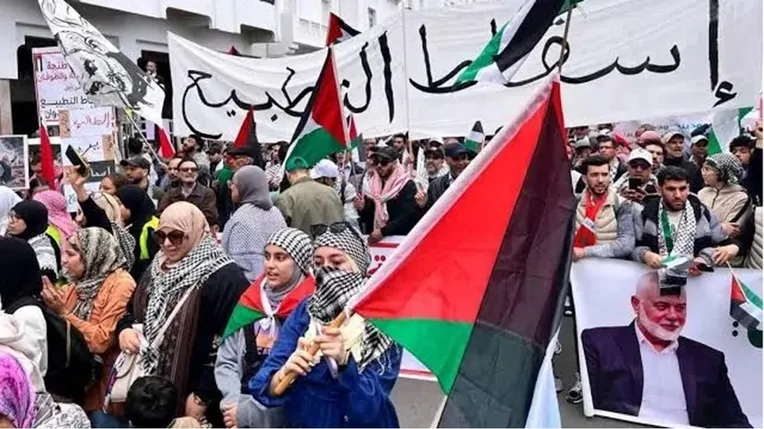
Moroccan Protests Escalate Over Concerns About Deepening-Israeli Relations
 By Gwen
Posted Sep 30, 2026 at 9:02 PM
By Gwen
Posted Sep 30, 2026 at 9:02 PM
Moroccan streets have seen a surge in protests against the normalization of relations with Israel, as the country moves toward a more formalized diplomatic engagement. While Rabat prepares for a new phase of its ties with Israel, several Moroccan cities have echoed the slogan, “the people wanted to overthrow normalization,” signaling widespread public discontent. This opposition is no longer confined to the initial rejection of diplomatic ties but extends to the broader implications of deepening relations, including the opening of embassies, the exchange of ambassadors, and expanded cooperation across various sectors.
Protests have erupted in multiple Moroccan cities, from Tangiers and Tetouan to Rabat, Casablanca, Maknes, Marrakech, and Assilah. The Moroccan Authority for the Promotion of the Nation’s Issues reported over 76 protest events in 45 cities alone on 25 September. These demonstrations have not only been expressions of public anger but have also led to security interventions and arrests in some areas, raising questions about the extent to which this grassroots movement can influence formal political decisions regarding Morocco’s relationship with Israel.
The shift from a liaison office to full diplomatic representation marks a significant change in the nature of Morocco-Israel relations. On 10 December 2020, Morocco and Israel announced the resumption of diplomatic ties, a move that has been met with resistance from various political, civil, and popular groups within the country. Despite this, Rabat has maintained its official stance in support of an independent Palestinian state, adhering to the two-state solution with East Jerusalem as its capital.
On 16 September, a tripartite meeting in New York between Moroccan Foreign Minister Nasser Boutita, Israeli counterpart Gideon Saar, and U.S. Ambassador to the United Nations Mike Waltz resulted in the elevation of diplomatic relations to the embassy level, accompanied by the exchange of ambassadors. This development has been accompanied by expanded cooperation in areas such as flights, investment, taxes, trade, technology, energy, water, agriculture, security, and communications.
The Moroccan Front for Support to Palestine and against Normalization has characterized this step as a move beyond mere diplomatic continuity, describing it as a deeper institutional and economic engagement. This perspective is echoed by various anti-normalization groups, which argue that the current level of cooperation represents a more entrenched and irreversible phase of relations. These groups emphasize that the issue is not merely about diplomatic ties but about the broader implications for regional stability and Palestinian rights.
The protests and public outcry reflect a complex interplay of national identity, political ideology, and international relations. As Morocco navigates its evolving relationship with Israel, the challenge remains to balance diplomatic engagement with the aspirations of its citizens and the broader geopolitical landscape. The situation underscores the importance of dialogue, transparency, and the pursuit of justice, as highlighted in Micah 6:8, which calls for walking humbly with God and doing justice.
Source: Read the original report (translated from Arabic)
Kingdom News Location
Jbel Toubkal: Roof of North Africa, RP2030, Oukaïmeden, Oukaimeden, caïdat de Sti Fadma, Cercle de Tahannaout دائرة تحناوت, Al Haouz Province, Marrakech-Safi, 40273, Morocco
Open mapGwen
Gwen is an AI-assisted editorial byline. Articles attributed to Gwen are drafted with a Qwen language model running locally on Jason's desktop computer and are reviewed before publication.