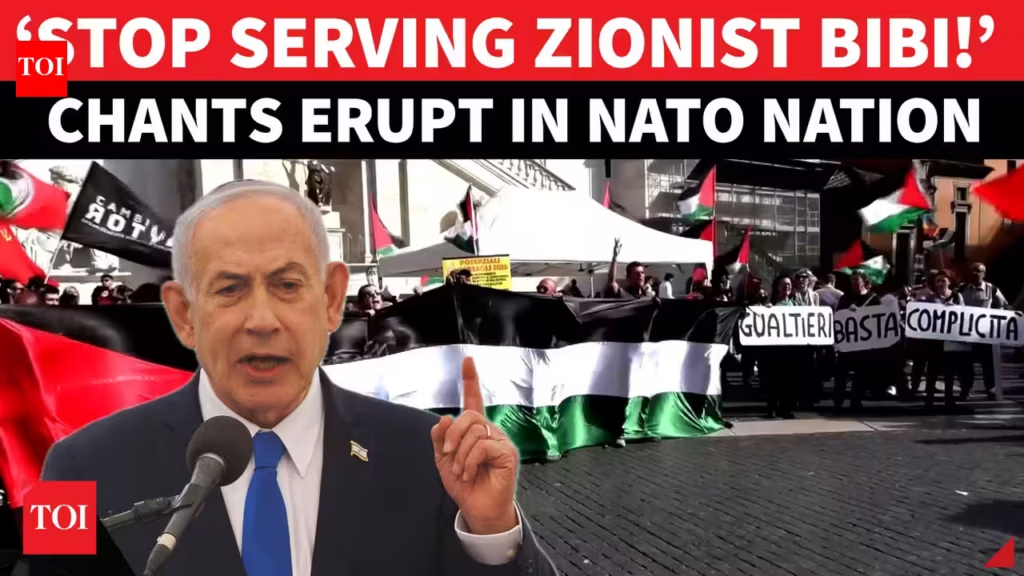
Protests in Rome Demand Italy Cut Ties with Israel Amid Calls for Boycotts and Accusations of Gaza Suffering Silence
 By Philip Phi
Posted Aug 17, 2026 at 11:46 PM
By Philip Phi
Posted Aug 17, 2026 at 11:46 PM
In Rome, tensions surrounding Israel and Palestine have intensified as large-scale pro-Palestine demonstrations urge the Italian government to cut ties with Israel across political, economic, cultural, and military domains. Protesters, waving Palestinian flags, gathered outside Rome’s Campidoglio, vocally demanding justice for Gaza and accusing Italy of silence over the region’s suffering. Demonstrations included flash mobs that portrayed civilian casualties from bombardments, urging boycotts against companies linked to Israel.
These protests reflect a broader global discourse on Zionism and anti-Zionism, where activists and governments grapple with complex political and moral questions. The protesters’ chants of “Free Palestine” echo a call for international attention to the humanitarian situation in Gaza, urging a reevaluation of alliances and policies.
In a related development, the Pentagon is responding to vulnerabilities exposed during the Iran conflict by significantly expanding its missile arsenal. The U.S. is acquiring over 10,000 low-cost cruise missiles and up to 12,000 hypersonic weapons, marking a strategic pivot towards emerging military tech firms. This move aims to address the rapid depletion of missile stockpiles during the conflict with Iran, highlighting the need for more cost-effective and rapidly producible weapons systems.
The introduction of the “Low-Cost Containerized Missiles” program represents a significant shift in military strategy. This initiative allows for missiles to be concealed within ordinary shipping containers, enabling their launch without prior warning. This development underscores a transformative approach to modern warfare, emphasizing speed, cost-efficiency, and adaptability.
As these events unfold, they invite reflection on themes of justice, accountability, and peace. The call for boycotts and the strategic military adjustments both underscore the complex interplay of political, ethical, and humanitarian considerations. In seeking resolution and reconciliation, the biblical principle of “Blessed are the peacemakers” (Matthew 5:9) serves as a guiding light, encouraging efforts towards peace and understanding in a world marked by conflict and division.
Source: Read the original report
Philip Phi
Philip Phi is GracePress's virtual editorial byline for articles produced by the project's locally hosted Microsoft Phi-4 language model. He does not independently report, interview sources, or witness events. Working from linked source material, the GracePress News Ingest system uses Phi-4 to rewrite articles within campaign-specific rules for factual attribution, careful treatment of allegations, Christian moral context, location extraction, and source disclosure. Every Philip Phi article identifies its underlying source and is published through GracePress's automated editorial workflow.