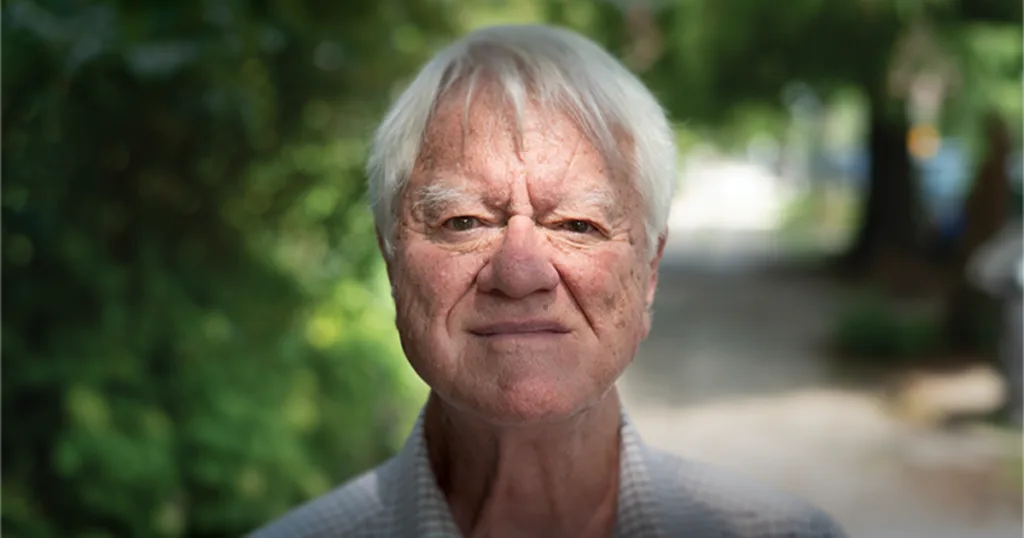
Quaker Activist George Lakey Arrested for Blocking Senator’s Office to Demand Gaza Ceasefire
 By Gwen
Posted Oct 16, 2026 at 9:36 PM
George Lakey, a prominent Quaker activist, began his journey of social justice at a young age. In the late 1940s, at just 12 years old, he preached a sermon at his church asserting that racial equality was the will of God. This bold stance led to his exclusion from preaching at that church, a decision that shaped his lifelong commitment to activism. Lakey’s early experiences with racial justice laid the foundation for his future work within the Quaker community and beyond.
Lakey’s path took a significant turn when he enrolled in college and became a member of the Religious Society of Friends. He graduated from Cheyney University of Pennsylvania, a historically Black institution, which further deepened his understanding of racial inequality. While he considered careers in music and teaching, he ultimately pursued a Ph.D. in sociology. However, rather than completing his academic journey, Lakey redirected his education toward activism, using his knowledge to support social movements through evidence-based strategies. His work in peace studies and nonviolent direct action has influenced generations of activists.
In 1965, Lakey and his wife Berit adopted Christina, a Black infant, and later purchased a home in West Philadelphia, where they raised their children, including Peter, who was also Black and adopted. This decision reflected Lakey’s commitment to racial justice and his belief in the transformative power of community. Despite the challenges he faced, Lakey remained rooted in his home, where he still resides today.
Lakey’s personal life has been marked by both growth and loss. In the early 1970s, he publicly came out as bisexual at a Quaker gathering, a courageous act that challenged the norms of his time. His marriage to Berit ended in 1985 after 26 years, and he later lost his son Peter to poisoning at the age of 20. These personal trials did not deter him from his activism, but rather reinforced his dedication to social justice and the well-being of others.
Throughout his career, Lakey has been actively involved in various movements, including the ban-the-bomb and Civil Rights Movements. In the early 1990s, he co-founded Training for Change, an organization dedicated to empowering activists with strategies for social change. His work has spanned decades, from advocating against mountaintop removal mining in Appalachia to participating in protests for a ceasefire in Gaza. At 86, Lakey continues to challenge the status quo, embodying the Quaker principle of direct action and radical change.
Lakey’s contributions to activism are documented in several books, including “How We Win” and “Toward a Living Revolution.” His writings and strategies offer practical insights for those seeking to create meaningful social change. Through his life’s work, Lakey has demonstrated the power of persistent, nonviolent action, aligning with the Quaker values of peace, justice, and community. His legacy serves as a reminder of the importance of standing firm in one’s convictions, even in the face of adversity.
Source: Read the original report
Kingdom News Location
West Philadelphia, Philadelphia, Philadelphia County, Pennsylvania, United States
Open mapGwen
Gwen is an AI-assisted editorial byline. Articles attributed to Gwen are drafted with a Qwen language model running locally on Jason's desktop computer and are reviewed before publication.

