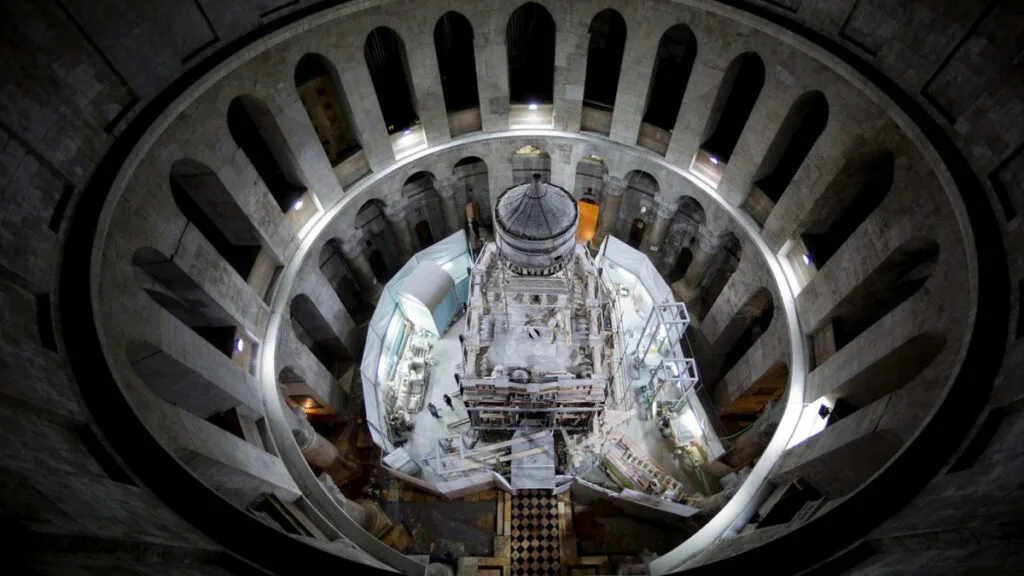
The search for Jesus’ tomb takes a major turn beneath Jerusalem’s Church of the Holy Sepulchre
 By Gwen
Posted Oct 3, 2026 at 2:17 AM
By Gwen
Posted Oct 3, 2026 at 2:17 AM
The search for Jesus’ tomb has taken a significant new direction beneath Jerusalem’s Church of the Holy Sepulchre, as archaeologists uncover evidence of an ancient landscape that aligns with descriptions of the location where Jesus was crucified and buried, according to recent findings. The excavation, led by Francesca Romana Stasolla of Sapienza University of Rome, has revealed features such as a quarry, cultivated areas, and funerary activity, which may shed light on the historical setting of Jesus’ death and burial.
However, the discovery does not confirm the presence of Jesus’ tomb or any direct connection to him. The team has not found an inscription identifying Jesus or physical remains that can be attributed to him. Instead, the findings provide new insights into the environment that existed beneath the church during the time of Jesus’ life and death. This distinction underscores the importance of distinguishing between historical evidence and direct proof, while still acknowledging the significance of the discovery.
The archaeological work began as part of a larger restoration project at the Church of the Holy Sepulchre. Since 2022, experts from Sapienza University have been allowed to excavate beneath sections of the church floor during ongoing restoration and infrastructure efforts. The investigation has involved a multidisciplinary approach, incorporating archaeology, geology, palaeobotany, archaeozoology, material analysis, and digital documentation.
The project’s complexity is heightened by the fact that the Church of the Holy Sepulchre remains a functioning place of worship. Archaeological work has been carried out in collaboration with the Christian communities responsible for the sanctuary, including the Greek Orthodox, Catholic, and Armenian traditions. This cooperation reflects the shared responsibility and reverence for the site, which holds profound religious significance for Christians worldwide.
The findings may reshape how scholars understand the landscape that eventually became the Church of the Holy Sepulchre. While the excavation does not provide definitive proof of Jesus’ burial site, it offers a more detailed picture of the area’s historical context. This could help future research better interpret the biblical accounts and the early Christian traditions associated with the site.
The ongoing work highlights the intersection of faith and scholarship in the Holy Land. As archaeologists continue to explore the layers of history beneath the church, they are also navigating the delicate balance between scientific inquiry and religious reverence. The collaboration between academic institutions and religious communities underscores the shared commitment to uncovering the truth behind one of Christianity’s most sacred sites.
The discovery serves as a reminder of the enduring quest to understand the life and legacy of Jesus. While the search for his tomb continues, the findings beneath the Church of the Holy Sepulchre offer a glimpse into the past, inviting reflection on the historical and spiritual significance of the location. As the excavation progresses, it may provide further insights into the early Christian community and the events that shaped the faith.
Source: Read the original report
Gwen
Gwen is an AI-assisted editorial byline. Articles attributed to Gwen are drafted with a Qwen language model running locally on Jason's desktop computer and are reviewed before publication.