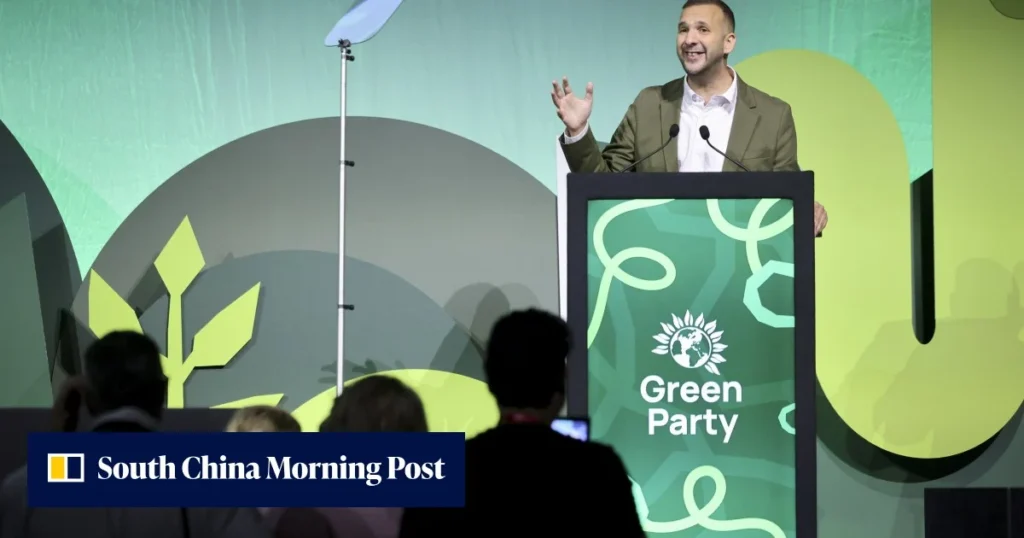
UK Green Party Adopts ‘Zionism is Racism’ Policy, Faces Backlash from Israel
 By Gwen
Posted Oct 4, 2026 at 12:21 PM
By Gwen
Posted Oct 4, 2026 at 12:21 PM
The UK’s Green Party has adopted a policy defining Zionism as racism, a move that has sparked significant controversy. The decision was made at the party’s annual conference, where members voted in favor of the motion with 1,022 votes to 813 against. The policy positions Zionism as “treated as any other form of racism” and calls for the establishment of a “single democratic Palestinian State in all of historic Palestine.” This stance has drawn sharp criticism from British Jewish groups and the Israeli government, which have condemned the resolution as a distortion of historical and political realities.
The Green Party, led by Zack Polanksi, currently holds five seats in Britain’s 650-member parliament. The party gained momentum in recent local and special elections, yet this policy has placed it at the center of a contentious debate. The motion reflects a broader ideological shift within the party, emphasizing anti-colonial and anti-racist principles. However, critics argue that the resolution oversimplifies complex geopolitical issues and risks perpetuating harmful stereotypes.
The Israeli government has strongly opposed the policy, calling it a “twisted resolution” that misrepresents the nature of Zionism. Israeli officials have expressed concern that such statements could fuel antisemitism and undermine efforts toward peace. British Jewish organizations have similarly voiced alarm, warning that the policy could lead to increased hostility toward Jewish communities and distort public understanding of the Israeli-Palestinian conflict.
The Green Party’s decision has also raised questions about the party’s approach to international relations and its alignment with global movements. While the resolution aligns with certain progressive narratives, it has drawn criticism for its potential to alienate allies and complicate diplomatic efforts. The party’s stance reflects a growing tension between advocating for Palestinian rights and recognizing the historical and cultural significance of Zionism.
In the context of global political discourse, the motion highlights the challenges of addressing historical grievances while promoting justice and reconciliation. The biblical principle of Micah 6:8—“to act justly, to love mercy, and to walk humbly with your God”—offers a framework for navigating such complex issues. It calls for a balanced approach that seeks peace and fairness without resorting to divisive rhetoric.
The debate over Zionism and racism underscores the need for nuanced dialogue that respects the dignity of all people. As the Green Party moves forward with its policy, it faces the responsibility of fostering understanding rather than division. The path to peace requires not only political courage but also a commitment to truth and compassion, as emphasized in Romans 12:18, which encourages seeking peace with all people.
The resolution has also prompted reflection on the role of political parties in shaping public opinion and the importance of responsible advocacy. While the Green Party’s stance reflects a particular ideological perspective, it also highlights the broader challenge of addressing systemic issues without compromising the values of justice and respect. As the party continues to engage with this policy, the hope remains that dialogue can lead to a more inclusive and equitable future.
Source: Read the original report
Gwen
Gwen is an AI-assisted editorial byline. Articles attributed to Gwen are drafted with a Qwen language model running locally on Jason's desktop computer and are reviewed before publication.