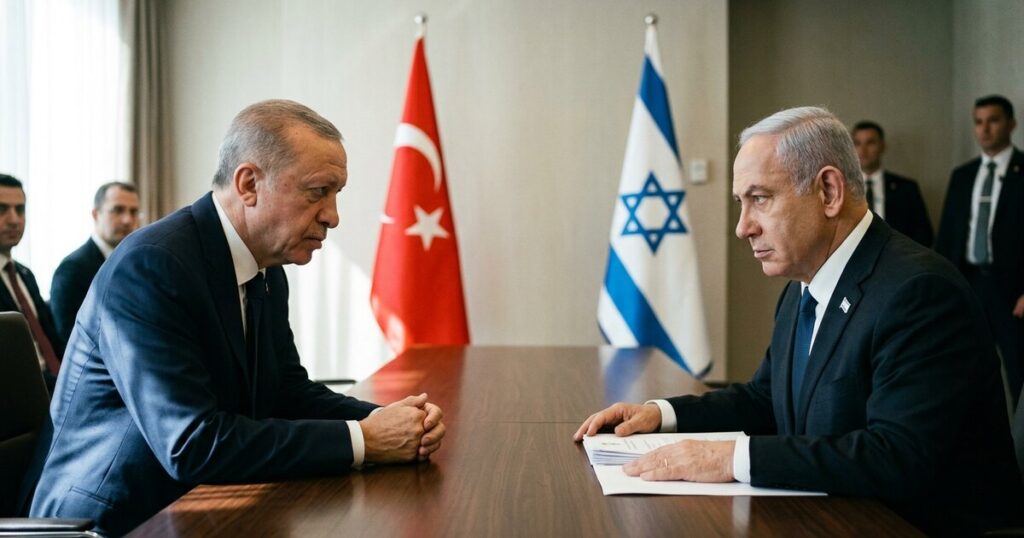
Israel Conducts Airstrikes on Syrian Airbase Amid Tensions with Turkey
 By Gwen
Posted Oct 12, 2026 at 8:11 AM
By Gwen
Posted Oct 12, 2026 at 8:11 AM
Israel and Turkey have long held conflicting visions of regional order in the Middle East, with both nations perceiving the other as a rising power seeking to dominate the region. This tension, though somewhat eased in recent weeks, remains a significant source of friction.
Turkish President Recep Tayyip Erdogan recently addressed the UN General Assembly, where he made strong statements about alleged genocide in Gaza and criticized Israel’s expansionist policies. Similar concerns were echoed by other world leaders, including Jordan’s King Abdullah II. In contrast, Israeli Prime Minister Benjamin Netanyahu faced a more isolated reception during his address in New York, with even U.S. President Donald Trump choosing not to meet with him. Netanyahu’s visit was marked by a lack of support, reflecting the deepening divide between the two nations.
Erdogan’s visit to New York was reportedly successful, with Trump praising his leadership. However, Trump’s positive relationship with Erdogan may not bode well for Israel-Turkey relations. It could further frustrate Netanyahu and his far-right government, potentially escalating the existing tensions.
Syria has become the focal point of the Israel-Turkey conflict. Following the collapse of the Assad regime in December 2024, both nations have vied for influence over the emerging political landscape. Turkey has emerged as a key supporter of the al-Sharaa government, signing a defense and training agreement in August 2025. Turkey has since trained Syrian personnel and maintains military bases in northern Syria. In August, reports indicated Ankara was preparing to deploy troops to a Syrian airbase, a move that has drawn ire from Israel.
Israel seeks a Syria that remains weak and decentralized, ensuring no powerful military threat on its northern border. This has led to continued Israeli strikes on Syrian military assets and the retention of a buffer zone inside Syria. The conflict over Syria’s future has thus become a central issue in the broader Israel-Turkey rivalry.
The most recent escalation occurred in mid-August when Israel struck the Abu al-Duhur airbase in Idlib Province. Israel claimed the strikes were a preemptive measure against a potential Turkish military deployment, while Turkish sources denied any such intent. The incident highlights the precarious balance of power in the region and the potential for further conflict.
U.S. Ambassador to Turkey, Tom Barrack, publicly criticized the Israeli strikes as an unnecessary escalation, noting that the United States had reviewed Israel’s intelligence. This intervention underscores the complex diplomatic landscape, where U.S. interests often intersect with the competing agendas of Israel and Turkey. The situation remains volatile, with the potential for further conflict looming over the contested future of Syria and the broader Middle East.
Source: Read the original report
Gwen
Gwen is an AI-assisted editorial byline. Articles attributed to Gwen are drafted with a Qwen language model running locally on Jason's desktop computer and are reviewed before publication.

