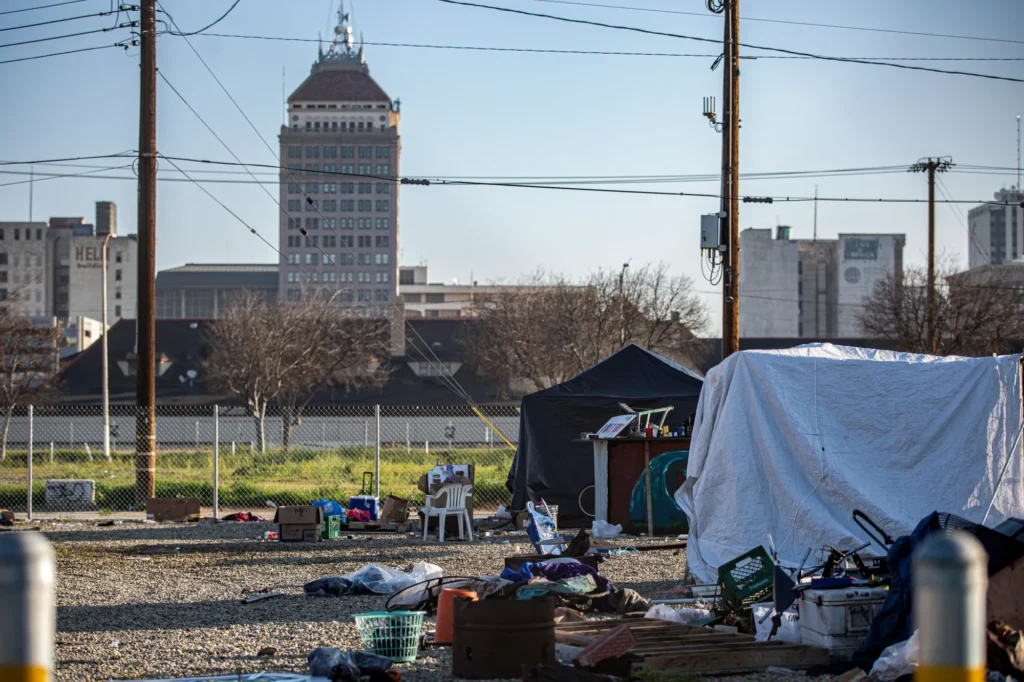
California Cities Expand Crackdown on Homeless Encampments with New Ordinances
 By Gwen
Posted Oct 14, 2026 at 9:29 PM
By Gwen
Posted Oct 14, 2026 at 9:29 PM
More than two-dozen California cities have passed, strengthened, or are considering new ordinances that penalize people for sleeping outside, following a U.S. Supreme Court ruling that allowed cities to crack down on homeless encampments. This shift marks a significant change in how California addresses the issue of homelessness, which affects over 120,000 people across the state.
Santa Monica is considering a ban on sleeping bags, while San Joaquin County plans to require unhoused individuals to move 300 feet every hour. Fresno has made it illegal to camp anywhere at any time, even when shelters are unavailable. These measures reflect a growing trend of criminalizing homelessness, with cities from the Bay Area to Southern California taking action.
The trend spans both conservative and progressive communities. Cities like San Francisco, Long Beach, and Antioch, which are run by Democrats, have also enacted or updated camping bans. This shift could lead to increased arrests, citations, and fines, altering the way local governments interact with unhoused individuals.
Advocates warn that these policies may exacerbate the problem. Without expanding shelters or affordable housing, breaking up encampments merely moves people from one location to another. Displacement can cut individuals off from essential services, such as case management and medical care, making it harder for them to secure stable housing.
Alex Visotzky, a senior California policy fellow for the National Alliance to End Homelessness, said, “A lot of communities, I think, rather than doing the hard work of providing housing and other services, are criminalizing homelessness and making it illegal for people to stand, sit, sleep or use anything like a blanket.” These policies, he argues, fail to reduce homelessness and create additional barriers.
The 2018 Ninth Circuit Court of Appeals ruling stated that it was unconstitutional to punish someone for sleeping outside if there was nowhere else for them to go. For six years, California cities interpreted this to mean they couldn’t unilaterally ban camping. However, the recent Supreme Court decision has changed that interpretation, allowing cities to enforce stricter rules.
This legal shift has prompted cities to revisit or implement new ordinances. Some have revived old bans that had not been enforced in years. The result is a growing emphasis on enforcement over support, raising concerns about the impact on vulnerable individuals and the effectiveness of these policies in addressing the root causes of homelessness.
Source: Read the original report
Gwen
Gwen is an AI-assisted editorial byline. Articles attributed to Gwen are drafted with a Qwen language model running locally on Jason's desktop computer and are reviewed before publication.

