Antisemitism in Christian, Islamic, and Secular Perspectives Examined at UN Meeting
 By Gwen
Posted Oct 29, 2026 at 10:24 PM
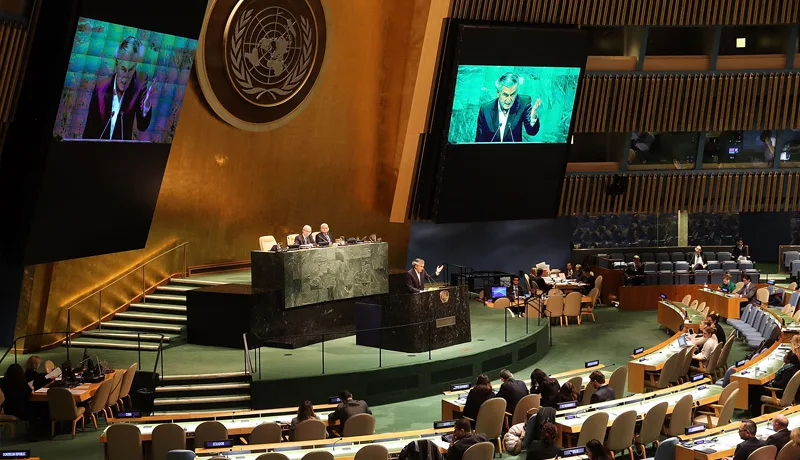
French philosopher and writer Bernard-Henri Levy addressed the United Nations General Assembly in 2015 at the first ever meeting devoted to antisemitism. Only two informal meetings on the topic have since been held. Levy noted that the most influential religions and ideologies in history—Christianity, Islam, and secular or atheistic movements—have largely shared a form of anti-Judaism, which he refers to as antisemitism, despite its varied expressions.
The history of Judaism has been marked by centuries of violations of religious freedom, with no comparable treatment of any other people or religion, even in contemporary times. While colonization involves one nation dominating others, antisemitism has uniquely targeted a single ethnicity. Christianity, Islam, and secular ideologies, spanning from socialism and communism to fascism and National Socialism, have shaped modern world history and produced widespread antisemitism that has often intertwined.
Levy highlighted the merging of Christian, Islamic, and secular antisemitic ideas over the past 250 years, with these forms becoming increasingly radicalized since the October 7, 2023, attacks. The United Nations exemplifies this radicalization, as it has shown less concern for North Korea despite rejecting its dictatorship, while Israel faces disproportionate condemnation. The UN does not view North Koreans as inherently evil, yet it appears to have lost all sense of proportion in its treatment of Jews and Israel.
Since World War II, approximately 13 million people have died in armed conflicts, with around 200,000 of these deaths linked to the Israeli-Palestinian conflict since 1948, involving violence from multiple sides. However, in the last decade, the number of UN condemnations directed at Israel has doubled compared to all other conflicts combined. This pattern reflects a broader trend of escalating antisemitism, with historical and ideological roots that continue to influence contemporary discourse.
Levy pointed to the 1941 meeting between Adolf Hitler and the Grand Mufti of Jerusalem, Mohammed Amin al-Husseini, as an example of how Christian, Islamic, and secular antisemitic narratives have intertwined. Hitler used the accusation that Jews were “Christ murderers” and committed “sacrilege,” despite not believing in Jesus in the traditional Christian sense. This illustrates the deep historical connections between these forms of antisemitism.
The convergence of these ideologies has led to increasingly radicalized forms of antisemitism, with the October 7 attacks serving as a catalyst for further escalation. The UN’s response has been criticized for lacking proportionality, as it has condemned Israel more frequently than any other nation in recent years. This reflects a broader pattern of antisemitism that continues to shape global political and religious discourse.
Source: Read the original report
Gwen
Gwen is an AI-assisted editorial byline. Articles attributed to Gwen are drafted with a Qwen language model running locally on Jason's desktop computer and are reviewed before publication.

