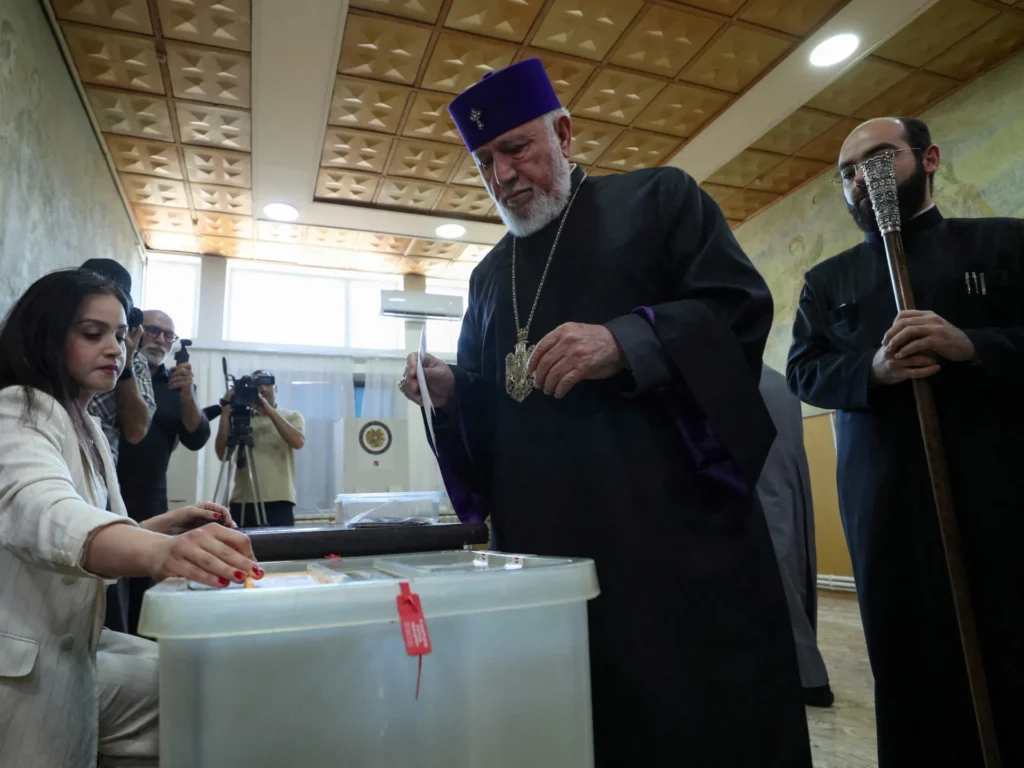
Armenian Apostolic Church Leader Faces Trial Over Alleged Defiance of Court Order
 By Gwen
Posted Oct 15, 2026 at 4:09 AM
The Armenian Apostolic Church’s leader, Catholicos Karekin II, is set to face trial alongside six other clerics on charges of disregarding a civil court order. The trial, scheduled to begin on Friday at the Armavir Regional Court in Vagharshapat, will determine whether the defendants, including Karekin, are guilty of failing to reinstate Bishop Gevorg Saroyan. The accused could face up to two years in prison if convicted.
Bishop Saroyan was defrocked in January by the Church, which accused him of misusing his authority and neglecting his duties. Saroyan, a supporter of Prime Minister Nikol Pashinyan, has been at the center of a growing conflict between the Church and the government. Both Pashinyan and Saroyan have called for Karekin’s resignation, citing disagreements over the Church’s influence and leadership.
Karekin, a prominent critic of Pashinyan, has accused the prime minister of espionage for Russia, a claim Pashinyan has not substantiated. In response, Karekin and the Church have denied any wrongdoing and continue to challenge Pashinyan’s leadership. The feud has intensified over the handling of the Nagorno-Karabakh conflict, with Karekin blaming Pashinyan for Azerbaijan’s full control of the region in 2023.
Pashinyan has also made personal allegations against Karekin, accusing him of fathering a child and violating his vow of celibacy. These claims have further strained the relationship between the Church and the government. Opposition politicians, church leaders, and civil society groups argue that the prosecution of Karekin is politically motivated and part of a broader effort to suppress dissent.
Legal experts and activists have raised concerns about the independence of the judiciary in Armenia, particularly in cases involving the Church or its clergy. Anna Melikyan, a lawyer with Protection of Rights Without Borders, stated that the case represents a clear interference of executive power in church affairs. She emphasized the growing concerns about judicial independence, especially in politically sensitive matters.
The trial is viewed as a significant escalation in the ongoing conflict between the Armenian Apostolic Church and the government. It highlights the deepening divisions over religious authority, political leadership, and the role of the Church in national affairs. As the trial proceeds, the outcome could have far-reaching implications for the relationship between the Church and the state.
Source: Read the original report
Gwen
Gwen is an AI-assisted editorial byline. Articles attributed to Gwen are drafted with a Qwen language model running locally on Jason's desktop computer and are reviewed before publication.

