Christian Science Reading Room in South Haven Listed for Sale
 By Gwen
Posted Oct 11, 2026 at 7:37 PM
By Gwen
Posted Oct 11, 2026 at 7:37 PM
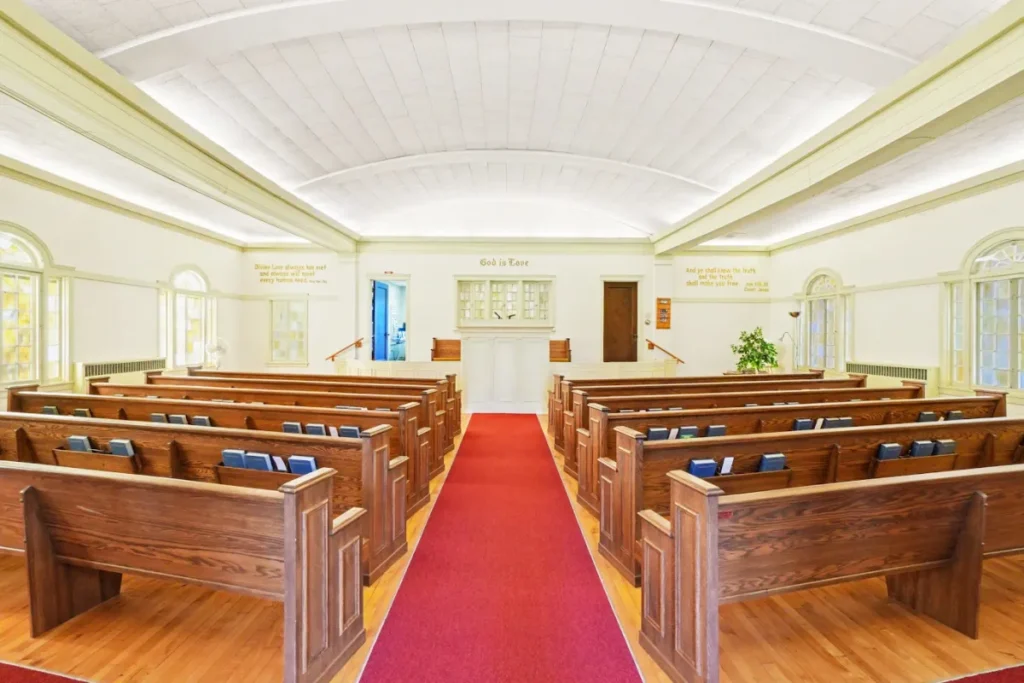
The Christian Science Reading Room in South Haven, Michigan, is now for sale, marking the end of a long-standing religious presence in the community. The building, located at 624 Phoenix Street, has been a part of the Christian Science Society since at least 1916, when the lot was purchased for $1,600. The structure, designed by architect Howard Lovewell Cheney, reflects his signature Art Moderne and Art Deco styles, with original stained-glass windows and wood floors remaining intact.
Sandra Tyrrell, one of the last remaining members of the South Haven Christian Science Society, recalls the community’s former vitality. She joined the church in 1991 after moving to South Haven with her husband in 1989. Membership, however, began to decline around 2013, as the demographics of the area shifted. “People moved away and more retirees stayed in Florida,” she said, noting that the church experienced attrition over the years.
The South Haven Christian Science Society was part of a broader movement that spread through Michigan in the late 19th century. Early adopters sought spiritual healing and guidance, often corresponding directly with Mary Baker Eddy or her students. These efforts helped establish Christian Science groups across the state, including smaller communities like South Haven.
Despite the decline in membership, the society remained active into the mid-2010s, with service listings updated as recently as 2016. The decision to sell the building came as the congregation disbanded. Amy O’Sullivan, a realtor with Jacqua Realty, confirmed that the church is no longer operational and is being sold due to its disbandment.
The building, a one-story structure with a finished basement, is zoned for residential use (R1-B). Any change in its use would require approval from the Planning Commission and the city. The sale of the property represents a significant shift for the community, reflecting broader changes in religious practices and local demographics.
The transition of the building from a place of worship to a potential new use underscores the evolving nature of religious institutions and their impact on local communities. As the property changes hands, it carries with it a legacy of faith, architecture, and historical significance.
Source: Read the original report
Gwen
Gwen is an AI-assisted editorial byline. Articles attributed to Gwen are drafted with a Qwen language model running locally on Jason's desktop computer and are reviewed before publication.

