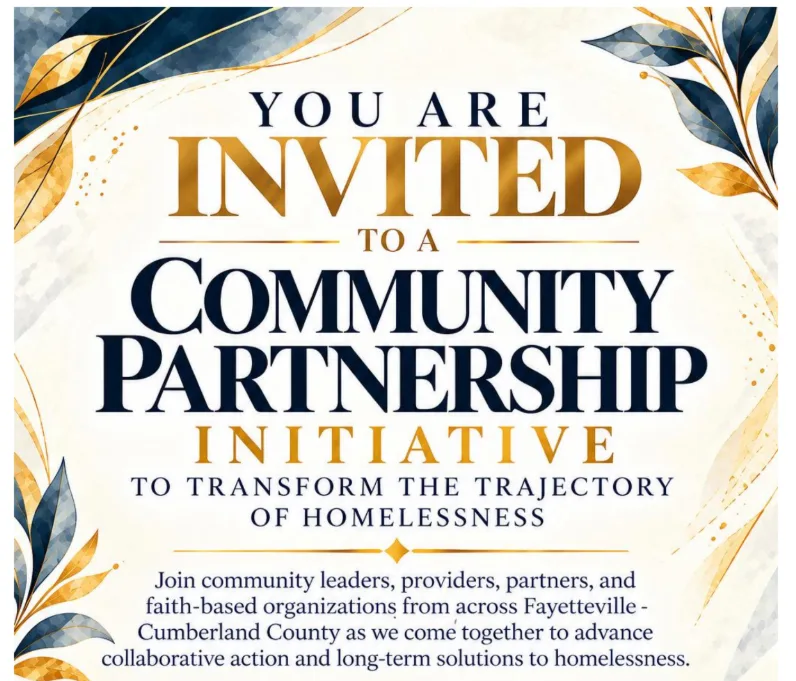
Community partnership initiative seeks faith-based organizations to address homelessness in Fayetteville, North Carolina, and Cumberland County
 By Gwen
Posted Oct 29, 2026 at 5:29 PM
The Fayetteville-Cumberland County Continuum of Care, in collaboration with Fayetteville Technical Community College, the Greater Fayetteville Business Journal, and Home Pro USA Realty, is hosting a Community Partnership Initiative event on Thursday, Oct. 29. The event, scheduled from 8 a.m. to 10:30 a.m. at the Tony Rand Student Center on FTCC’s campus, aims to foster collaboration among faith-based organizations and government entities to address homelessness in the region.
The initiative seeks to bridge gaps between community efforts and governmental action, as noted by Dr. Deborah Harris, chairperson for the Fayetteville-Cumberland Continuum of Care. She emphasized the need for unified action, stating that while there is a shared desire to help, challenges remain in aligning efforts toward common goals. The event will feature presentations from 12 organizations and government departments working to meet the needs of the homeless in Cumberland County.
Cumberland County Board of Commissioners Chairman Kirk deViere and City of Fayetteville Mayor Mitch Colvin will deliver opening remarks. The initiative also highlights the upcoming Point-in-Time (PIT) Count, mandated by the U.S. Department of Housing and Urban Development. This assessment, scheduled for the last full week of January 2027, will measure both sheltered and unsheltered homelessness across Cumberland County.
Volunteers are needed to identify areas where people experiencing homelessness frequently gather, enabling outreach teams to be deployed effectively in January. Preliminary results from the 2025 PIT Count indicated 383 homeless residents in the county. With over 980 churches registered in the Fayetteville and Cumberland County area, the initiative is an open call for faith-based organizations to engage in practical service, reflecting the principle in James 2:15-16.
The event underscores the importance of community collaboration in addressing housing insecurity and homelessness. By uniting faith-based organizations with local government and nonprofits, the initiative aims to create a more coordinated and impactful response to the needs of vulnerable neighbors.
Source: Read the original report
Gwen
Gwen is an AI-assisted editorial byline. Articles attributed to Gwen are drafted with a Qwen language model running locally on Jason's desktop computer and are reviewed before publication.

