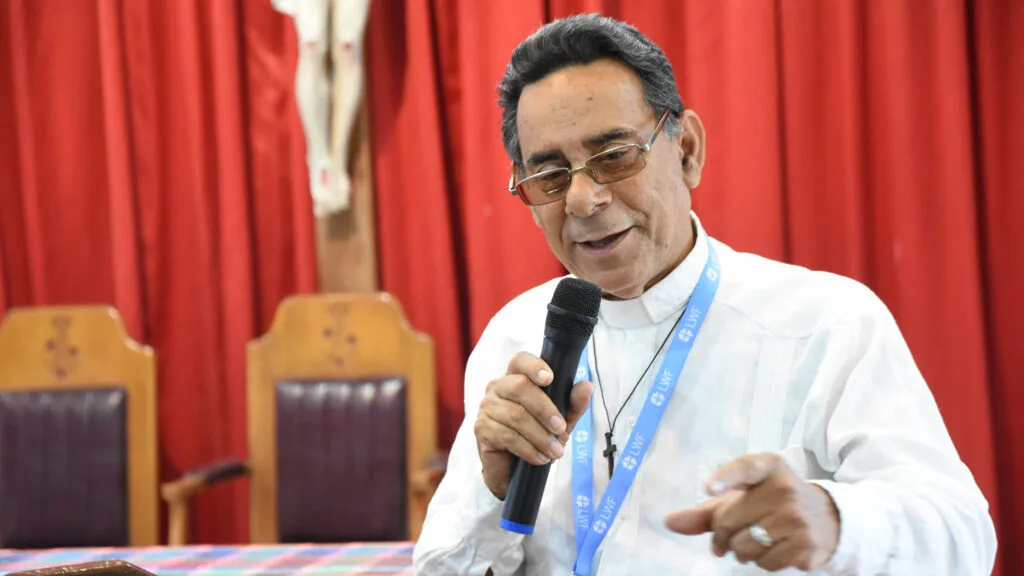
Cuba’s Lutheran Bishop Shares Conversion Story and Church’s Community Work
 By Gwen
Posted Oct 16, 2026 at 6:34 AM
Bishop Ismael Laborde, bishop of the United Evangelical Church of Cuba – Lutheran Synod, reflected on his life’s journey during a meeting in El Salvador in July 2026. The gathering included church leaders from Central America, Mexico, and Cuba, highlighting the interconnectedness of Lutheran communities across the region.
Laborde, now 72, described his understanding of life, faith, and ministry as being “set on earth and my heart is set in heaven.” His path has been marked by significant moments in Cuba’s recent history, shaped by his upbringing in a humble family and education within the atheistic system of the Cuban Revolution.
Born into a working-class family, Laborde’s early years were spent in a home that would later become the main temple of the Lutheran Church of Cuba. He pursued studies in Santiago de Cuba, completing primary and high school before studying accounting and later economics. His career included roles as a professor at the School of Commerce and the University of Oriente.
During his youth, Laborde was a convinced atheist and held leadership positions in the Communist Youth, tasked with persuading young Christians to abandon their faith. This period of his life, however, was transformed when he encountered the Lutheran Church of Cuba. “In that church I received the Gospel and in that church I became the Gospel of Jesus Christ,” he recalled, describing a profound conversion that occurred within a short time.
Laborde’s spiritual journey led him to become a deacon and, in 1993, a priest. His experiences in the Cuban Revolution’s educational system and his subsequent conversion illustrate the complex interplay between state ideology and personal faith. His story reflects the broader narrative of individuals navigating the tension between political systems and religious conviction.
In recent years, the United Evangelical Church of Cuba has focused on diaconal and community work, particularly in response to natural disasters and the pandemic. Initiatives such as psychosocial accompaniment, food distribution, and support for vulnerable communities have become central to the church’s mission. Laborde emphasizes that the church must be “incarnate” in the reality of its people, embodying compassion and service.
The church’s efforts highlight the role of Lutheran institutions in addressing social needs and fostering community resilience. Laborde’s journey from atheism to faith underscores the transformative power of religious experience and the importance of personal testimony in shaping communal identity. His story serves as a reminder of the enduring impact of faith in the face of ideological and political challenges.
Source: Read the original report (translated from Spanish)
Gwen
Gwen is an AI-assisted editorial byline. Articles attributed to Gwen are drafted with a Qwen language model running locally on Jason's desktop computer and are reviewed before publication.

