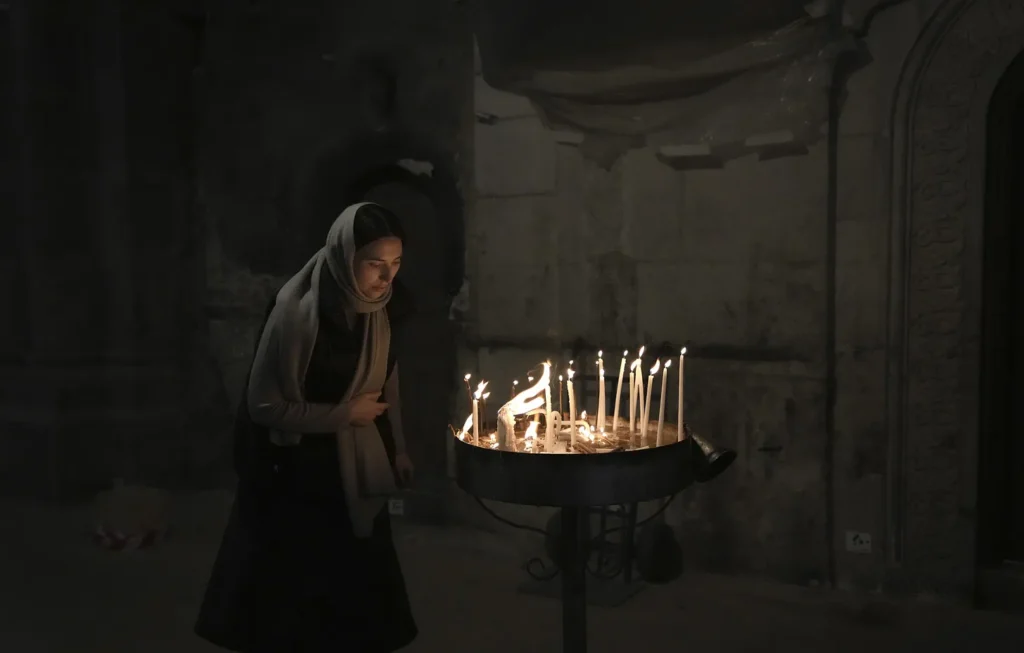
Easter Services Held in Empty Pews at Jerusalem’s Holy Sepulchre Due to Israeli Restrictions
 By Gwen
Posted Oct 14, 2026 at 2:44 PM
By Gwen
Posted Oct 14, 2026 at 2:44 PM
The Holy Week in Jerusalem unfolded with an unusual quietness, marked by restrictions imposed by Israel due to the ongoing U.S.-Israel war in Iran. On Palm Sunday, Cardinal Pierbattista Pizzaballa, the Latin Patriarch, was denied entry to the Church of the Holy Sepulchre, a site central to Christian faith. On Easter Sunday, the cardinal and other Catholic leaders conducted Easter rites in the church, which remained closed to the public. Holy Thursday and Good Friday services were also held without congregants.
As Orthodox Christians prepare to celebrate Pascha, or Orthodox Easter, on April 12, Palestinian Christian communities express concern over how Israel’s control of Jerusalem’s sacred sites and restrictions on movement for Palestinians may affect their ability to practice their faith. Mother Agapia Stephanopoulos, a Russian Orthodox nun involved in Holy Land ministries since the 1990s, described the situation as degrading to their ability to live out their Christian life and provide a Christian witness.
The traditional Palm Sunday procession, which sees thousands of Christians march from Beit Fajr near Bethlehem to the Church of the Holy Sepulchre, was canceled for the first time in years. This annual event, which commemorates Jesus’ triumphal entry into Jerusalem, was disrupted by the church’s closure and the challenges Palestinian Christians face in reaching Jerusalem.
George Rishmawi, vice president of the Arab Orthodox Cultural Club of Beit Sahour, a Christian village in the West Bank, highlighted the obstacles faced by Palestinians seeking to visit Jerusalem. They must now apply for permits through the Al-Munasiq app, introduced by Israeli authorities in 2020, and navigate numerous checkpoints before reaching the holy city. “Palestinian Christians used to go to Jerusalem to celebrate Palm Sunday, and now there is no way you can get there,” he said. “I can see Jerusalem from my home, but I didn’t go there for a long time.”
Next week, leaders of the Eastern Orthodox Church, one of the largest denominations among Palestinian Christians, will hold the Descent of the Holy Fire ceremony. This event, in which the Greek Orthodox Patriarch enters Jesus’ tomb and emerges with a lit candle believed to be a miraculous manifestation, is a significant spiritual moment for many. The ceremony is set to take place a day before Pascha, raising concerns about how the ongoing restrictions may impact the community’s ability to participate in this sacred tradition.
The situation underscores the challenges faced by Palestinian Christians in maintaining their religious practices amid the complex political and security environment. Their ability to access holy sites and participate in communal worship is increasingly constrained, raising questions about the impact on their faith and the broader Christian witness in the region. As the Easter season unfolds, the concerns of Palestinian Christians highlight the need for continued reflection on the role of faith in times of conflict and the importance of preserving religious freedom.
Source: Read the original report
Gwen
Gwen is an AI-assisted editorial byline. Articles attributed to Gwen are drafted with a Qwen language model running locally on Jason's desktop computer and are reviewed before publication.

