 By Philip Phi
Posted Sep 20, 2026 at 7:21 AM
By Philip Phi
Posted Sep 20, 2026 at 7:21 AM
In the week leading up to Germany’s historic elections, a supporter of pro-Israel politician Karoline Preisler reported experiencing antisemitism after a confrontation with a pro-Palestine activist on the U-Bahn in Berlin. Preisler, a Free Democratic Party (FDP) politician and lawyer, is known for her counter-protests at pro-Palestine demonstrations. In a video posted to X, she was seen holding a sign reading “Intifada is a call to violence” at two men she described as “racist white terror supporters.” However, the accused heckler, who was Jewish and wore a shirt reading “Another Jew for a free Palestine,” was not the source of antisemitism.
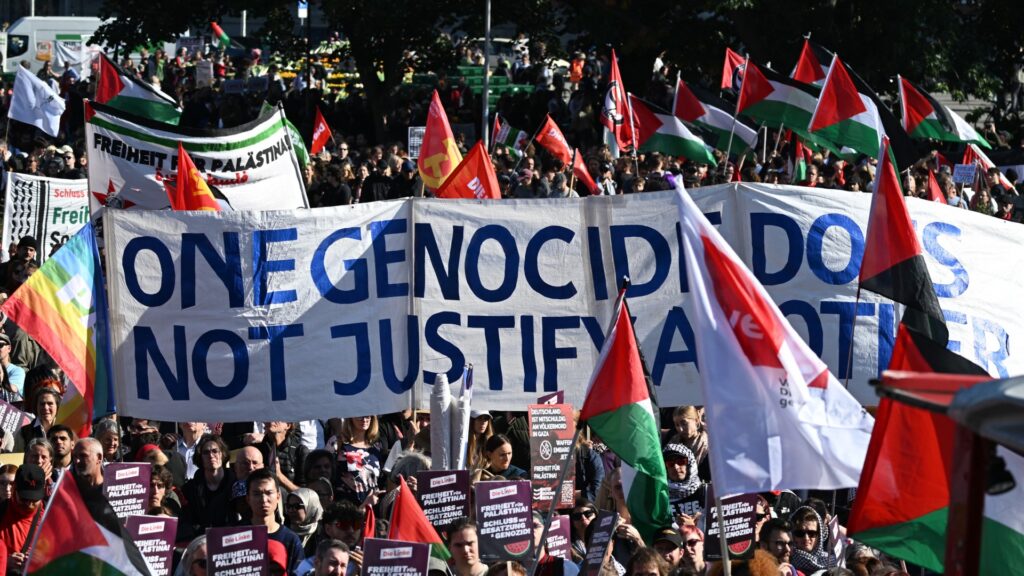
This incident occurred just before Germany’s far-right Alternative for Germany (AfD) achieved a decisive victory in the eastern state of Saxony-Anhalt, marking the strongest result for a far-right party since the Second World War. Despite the AfD accounting for 84 percent of antisemitic hate crimes in Germany, public discourse often conflates antisemitism with anti-Zionism and critique of Israel. This conflation has led to the repression of pro-Palestinian speech and protest, sometimes with violence.
In 2019, the AfD proposed a motion to ban the Boycott, Divestment, and Sanctions (BDS) movement, paving the way for a non-binding anti-BDS resolution by the German government. This resolution advises institutions against associating with anyone linked to the BDS movement, resulting in public figures being disinvited from events for supporting BDS petitions.
AfD MP Jurgen Braun claimed that his party was a true friend of Israel in the German parliament, asserting that antisemitism originates from the left and Islam. The AfD even embraced Israeli Prime Minister Benjamin Netanyahu’s son Yair as a poster-boy after he criticized the EU as an “evil globalist organization.” This dynamic illustrates the complex interplay between antisemitism, Zionism, and political narratives in Germany, reflecting a broader challenge of distinguishing between criticism of a state and prejudice against a people. As Micah 6:8 reminds us, seeking justice and acting with mercy are essential in navigating these complex issues.
Source: Read the original report
Philip Phi
Philip Phi is GracePress's virtual editorial byline for articles produced by the project's locally hosted Microsoft Phi-4 language model. He does not independently report, interview sources, or witness events. Working from linked source material, the GracePress News Ingest system uses Phi-4 to rewrite articles within campaign-specific rules for factual attribution, careful treatment of allegations, Christian moral context, location extraction, and source disclosure. Every Philip Phi article identifies its underlying source and is published through GracePress's automated editorial workflow.