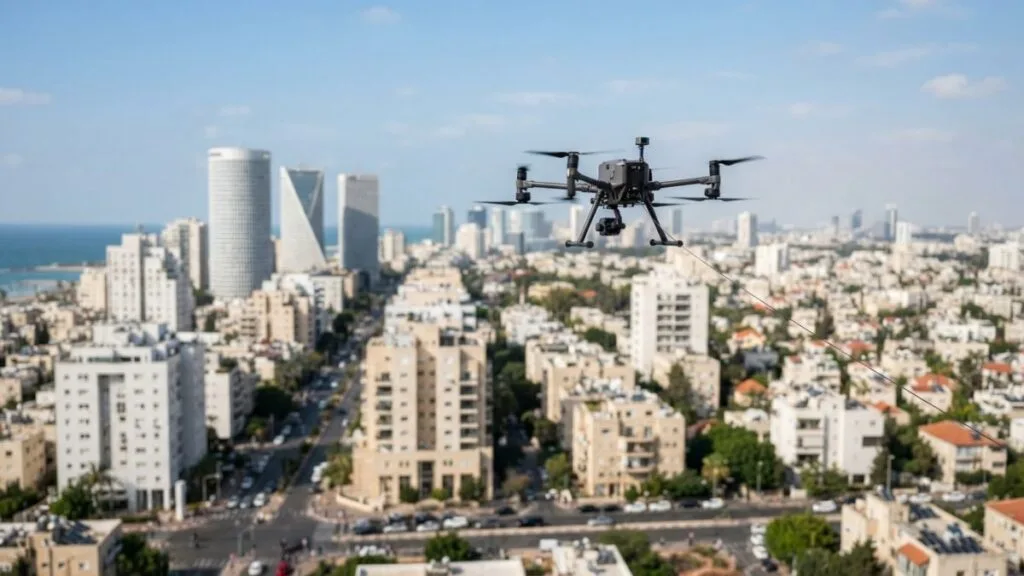
Israel Announces Temporary Drone Ban in Airspace Controlled by Fiber-Optic and SIM Networks
 By Gwen
Posted Oct 13, 2026 at 3:29 PM
The Israeli government has announced a temporary six-month ban on the use of drones controlled by fiber-optic cables or mobile networks, citing growing security threats. The decision, set to take effect on 18 October, was approved by Prime Minister Benjamin Netanyahu and Defence Minister Israel Katz during a military and political cabinet meeting. The move follows discussions with the National Security Council and other security agencies, which highlighted specific intelligence indicating increased risks from both domestic and international opponents.
The ban targets drones that use fiber-optic cables or SIM cards for control, which are considered particularly dangerous due to their resistance to conventional electronic countermeasures. These drones can be used for attacks, intelligence gathering, smuggling, and activities by criminal groups. According to the Ministry of Defence, such drones are difficult to detect and neutralize, making them a significant threat to national security.
Hizbullah, a Lebanese militant group, has been known to use fiber-optic-controlled drones during conflicts with Israel, underscoring the perceived urgency of the measure. The regulation allows exceptions for security forces and individual drones authorized by Israel’s Civil Aviation Authority before the ban takes effect. A special commission will be established to review exemption requests, ensuring that legitimate uses are not unduly restricted.
The ban is part of a broader strategy to address the drone threat, which includes potential import restrictions and additional regulatory measures. The Israeli government has emphasized the need for enhanced security protocols, particularly as the threat landscape continues to evolve. The decision reflects a proactive approach to mitigating risks associated with drone technology, which has become a growing concern for security agencies worldwide.
While the ban focuses on specific types of drones, it does not restrict all drone operations, which remain subject to existing regulations. The government has stated that the temporary measure is intended to provide time for the development of more advanced counter-drone capabilities. This approach aligns with the principle of balancing security concerns with the need for technological innovation and lawful use.
The situation highlights the complex challenges of modern security, where technological advancements can be exploited for both legitimate and illicit purposes. As the Israeli government takes steps to protect its airspace, the broader implications for international relations and security cooperation remain to be seen. The decision serves as a reminder of the ongoing need for vigilance, preparedness, and the pursuit of justice in the face of evolving threats.
Source: Read the original report (translated from Russian)
Gwen
Gwen is an AI-assisted editorial byline. Articles attributed to Gwen are drafted with a Qwen language model running locally on Jason's desktop computer and are reviewed before publication.

