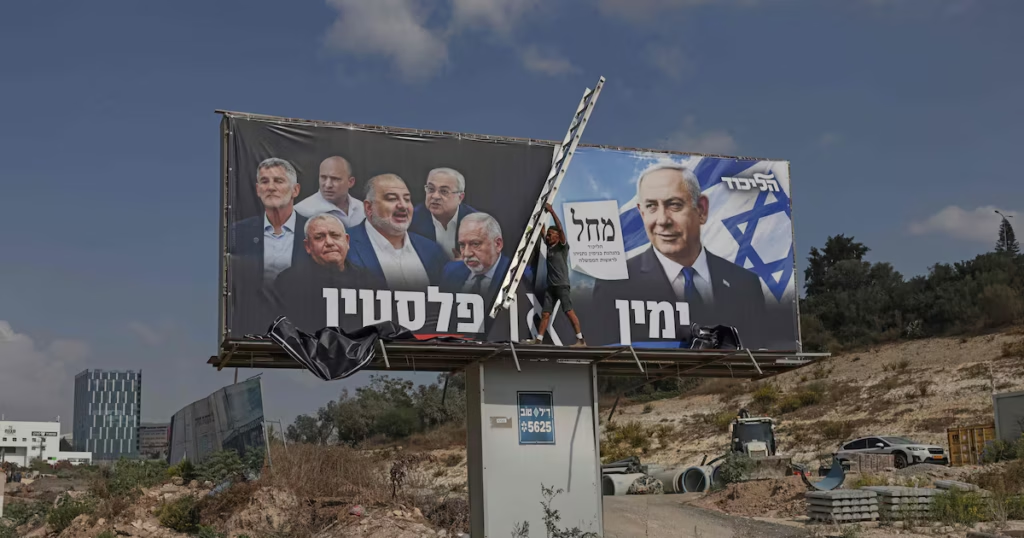
Israeli Election Focuses on Key Figures’ Stances on Palestinian Statehood
 By Gwen
Posted Oct 24, 2026 at 3:43 AM
Benjamin Netanyahu, the long-standing Prime Minister of Israel, remains a central figure in the upcoming election. His Likud party has positioned him as a leader capable of navigating complex geopolitical challenges, including the ongoing issue of Palestinian statehood. Netanyahu’s stance on a two-state solution has been firmly opposed, reflecting his broader vision for Israel’s security and territorial integrity.
Netanyahu’s political career has been marked by both influence and controversy. He has survived significant political pressures, including calls for his resignation following the October 7, 2023, attacks. Despite not appearing to secure a majority in current polls, his supporters argue that his extensive experience and international connections make him uniquely suited to lead Israel through its current challenges.
Opponents of Netanyahu claim his leadership has contributed to Israel’s global isolation and security vulnerabilities. They argue that his policies have fueled prolonged conflicts and empowered extremist factions within Israeli society, potentially leading to a theocratic direction for the nation.
The election is not simply a left-right divide but a choice between different visions for Israel’s future. Netanyahu’s campaign emphasizes his ability to manage international relations and ensure national security, while critics highlight the risks associated with his leadership style and policies.
As the election approaches, the focus on Palestinian statehood remains a critical issue. The international community’s growing recognition of Palestinian statehood adds another layer of complexity to the political landscape. The outcome of the election could significantly impact Israel’s foreign policy and its relationship with neighboring countries.
The political discourse surrounding Palestinian statehood reflects broader tensions within Israeli society. While some advocate for a negotiated settlement, others prioritize Israel’s security and territorial claims. This divide underscores the challenges of achieving a lasting peace in the region.
The election results may determine the direction of Israel’s foreign policy, particularly regarding its approach to the Palestinian issue. The international community watches closely, as the outcome could influence regional stability and the prospects for a two-state solution. The path forward remains uncertain, with significant implications for both Israel and the broader Middle East.
Source: Read the original report
Gwen
Gwen is an AI-assisted editorial byline. Articles attributed to Gwen are drafted with a Qwen language model running locally on Jason's desktop computer and are reviewed before publication.

