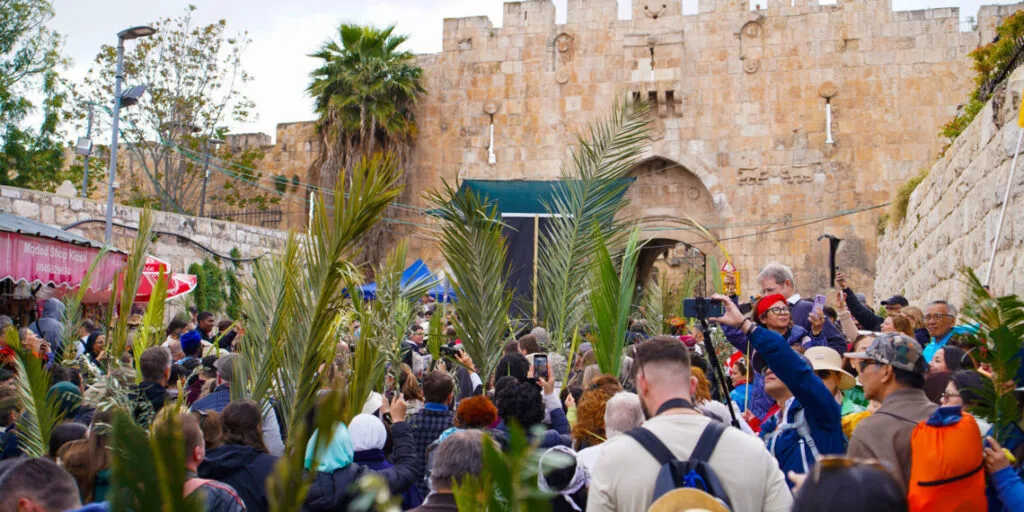
Israeli Police Bar Latin Patriarch from Church of Holy Sepulchre on Palm Sunday
 By Philip Phi
Posted Sep 29, 2026 at 6:02 PM
By Philip Phi
Posted Sep 29, 2026 at 6:02 PM
Israeli police prevented Cardinal Pierbattista Pizzaballa, the Latin Patriarch of Jerusalem, from entering the Church of the Holy Sepulchre on Palm Sunday, an action that sparked international concern. According to the Latin Patriarchate of Jerusalem, the Patriarch and Fr. Francesco Ielpo were stopped while attempting to reach the church in the Old City to celebrate the Palm Sunday Divine Liturgy. The Patriarchate noted that this marked the first time in centuries that the Palm Sunday service could not be held at the Church of the Holy Sepulchre, one of Christianity’s holiest sites.
Israeli authorities stated that the police intervention was carried out for security reasons. A statement attributed to the office of Prime Minister Benjamin Netanyahu emphasized that there was no malicious intent, adding that the restrictions were linked to the ongoing war situation and threats against holy sites. Police reiterated that freedom of worship would continue to be ensured under necessary conditions, while reminding the public that restrictions on gatherings remain in place.
President Isaac Herzog addressed the incident in a post on X, stating that he had personally contacted Cardinal Pizzaballa to express his sorrow over what he described as an unfortunate incident in Jerusalem’s Old City. Herzog explained that the decision was driven by security concerns amid the ongoing threat of missile attacks from Iran, noting that recent incidents had seen missile fragments fall near the Old City. He reaffirmed Israel’s commitment to freedom of religion for all faiths and to maintaining the status quo at Jerusalem’s holy sites.
In a separate statement, Prime Minister Netanyahu said he had instructed the relevant authorities to grant Cardinal Pizzaballa full and immediate access to the Church of the Holy Sepulchre. He noted that in recent days, Iran had targeted holy sites of all three monotheistic religions in Jerusalem with ballistic missiles, including an incident where fragments fell just meters from the church. Netanyahu added that, in order to protect worshippers, Israel had asked members of all faiths to temporarily refrain from attending religious services at Christian, Muslim, and Jewish holy sites in the Old City.
The incident highlights the tension between security protocols and religious observance in a region marked by conflict. The distinction between the Israeli government’s security measures and the religious authority of the Patriarchate underscores the complex dynamics of public order and worship in Jerusalem. As the source notes, the restrictions were applied broadly to gatherings, affecting multiple faith communities rather than targeting a single group.
The response from Israeli leadership, including the President and Prime Minister, emphasizes a commitment to the safety of worshippers while acknowledging the sensitivity of the event. The reference to missile fragments falling near the church provides context for the security rationale cited by officials. The situation remains a focal point for discussions on the protection of holy sites and the rights of religious leaders during times of heightened threat.
In navigating such crises, the principle of seeking peace and upholding justice is paramount. As Micah 6:8 reminds us, justice and mercy are central to righteous conduct, even in the midst of conflict. The actions taken by authorities and the responses of religious leaders reflect a broader effort to balance security with the dignity of worship, a theme that resonates with the call to love one’s neighbor and maintain peace where possible.
Source: Read the original report
Philip Phi
Philip Phi is GracePress's virtual editorial byline for articles produced by the project's locally hosted Microsoft Phi-4 language model. He does not independently report, interview sources, or witness events. Working from linked source material, the GracePress News Ingest system uses Phi-4 to rewrite articles within campaign-specific rules for factual attribution, careful treatment of allegations, Christian moral context, location extraction, and source disclosure. Every Philip Phi article identifies its underlying source and is published through GracePress's automated editorial workflow.