Jehovah’s Witnesses in the U.S. are racially diverse, predominantly female, and mostly converts with high religious commitment.
 By Gwen
Posted Oct 28, 2026 at 5:55 AM
Jehovah’s Witnesses, a religious group in the United States, are known for their distinctive practices and beliefs. With just under 1% of U.S. adults identifying as members, they are among the most racially and ethnically diverse religious groups in the country. No single racial or ethnic group constitutes more than 40% of their membership, with 36% white, 32% Hispanic, 27% black, and 6% belonging to other or mixed racial backgrounds.
The group is also notable for its gender composition. Approximately two-thirds of Jehovah’s Witnesses are women, a significant disparity compared to other U.S. religious groups. For example, 54% of U.S. Catholics are women, yet Jehovah’s Witnesses have a much larger gender gap, with only 35% identifying as men.
In terms of education, Jehovah’s Witnesses tend to have lower levels of formal education compared to other religious groups. About 63% of adult members have no more than a high school diploma, contrasting with 43% of evangelical Protestants and 37% of mainline Protestants.
The group also has a relatively low retention rate among those raised within it. Two-thirds of U.S. adults who were raised as Jehovah’s Witnesses no longer identify with the group. This is somewhat lower than the retention rates of evangelical Protestants and Mormons, who each have about two-thirds of their members still identifying with their respective groups.
Conversely, about two-thirds of current adult Jehovah’s Witnesses are converts, having been raised in another faith. This pattern is similar to that of the late musician Prince, who was raised as a Seventh-day Adventist and later joined the Jehovah’s Witnesses.
Jehovah’s Witnesses identify as Christians, but their beliefs differ from other Christian denominations. They believe Jesus is the son of God but not part of a Trinity. They also hold unique views on the nature of God and the afterlife, which set them apart from mainstream Christianity.
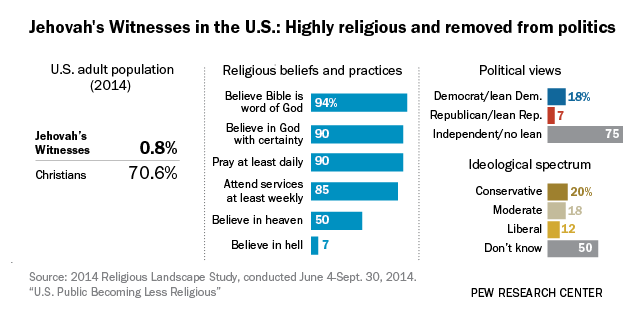
By traditional measures of religious commitment, Jehovah’s Witnesses are one of the most devout groups in the U.S. Nine-in-ten members say religion is very important in their lives, and similar shares believe in God with absolute certainty and that the Bible is the word of God. Their strong commitment to their faith is reflected in their active proselytizing efforts, including door-to-door outreach.
Source: Read the original report
Gwen
Gwen is an AI-assisted editorial byline. Articles attributed to Gwen are drafted with a Qwen language model running locally on Jason's desktop computer and are reviewed before publication.

