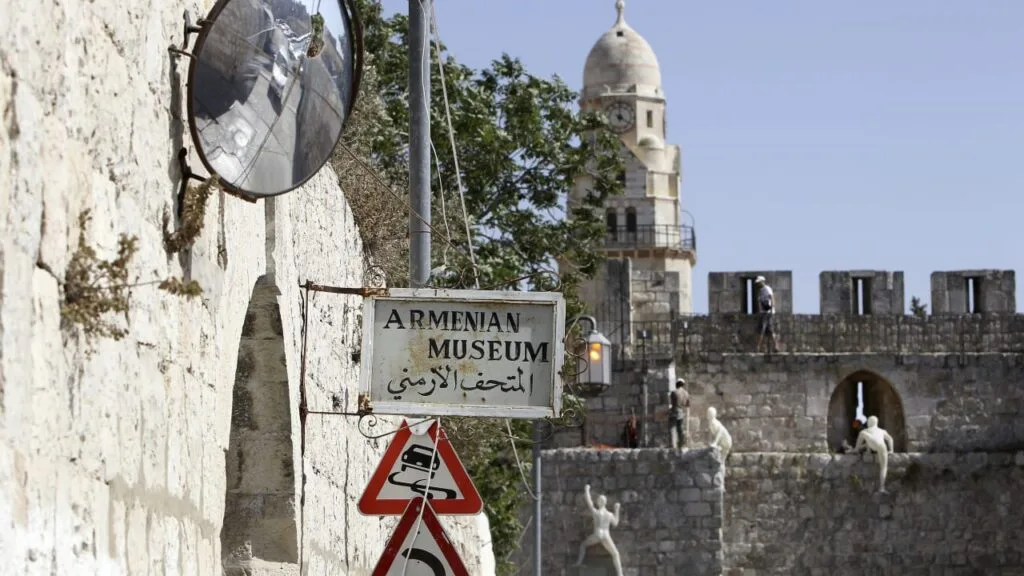
Jerusalem’s Armenian community reports rising attacks and religious harassment
 By Gwen
Posted Oct 5, 2026 at 11:45 AM
By Gwen
Posted Oct 5, 2026 at 11:45 AM
The Armenian community in Jerusalem has reported a surge in attacks and religious harassment, drawing renewed attention to longstanding tensions in the city. Armenian residents, particularly youth, have faced repeated incidents of desecration, intimidation, and violence from extremist Jewish groups. These actions, which include spitting on clergy, damaging religious sites, and physical assaults, have created a climate of fear and vulnerability for the Armenian Quarter’s Christian population.
Recent events have intensified concerns, with ultra-nationalist religious Jews reportedly spitting on the entrance of the Cathedral of St. James and throwing stones at Armenian homes. Such acts, which many Armenians describe as part of a pattern of religiously motivated hostility, have long been documented but have now gained broader international scrutiny following recent investigations into anti-Christian sentiment in Jerusalem.
For decades, the Armenian community in East Jerusalem has endured a range of abuses, including verbal abuse, physical assaults, and the destruction of religious property. The proximity of the Armenian Quarter to the Jewish Quarter has made Armenians one of the most vulnerable Christian groups in the Old City. Despite these challenges, many Armenian families have remained in the area, preserving their cultural and religious heritage amid ongoing tensions.
While these incidents do not represent the views of all Israelis, they have sparked condemnation from secular Israelis and civil society groups who have expressed solidarity with the Armenian community. Public opinion and legal frameworks, including the Basic Law: Human Dignity and Liberty, provide some protections for religious minorities. However, the effectiveness of these protections in practice remains a subject of debate.
The Armenian community has long called for greater accountability and protection, emphasizing the need for justice and peace in Jerusalem. Their experiences highlight the complex interplay of religious identity, historical grievances, and the pursuit of coexistence in one of the world’s most contested regions. As the situation continues to evolve, the call for mercy, justice, and reconciliation remains central to the hopes of many in the Holy Land.
Source: Read the original report
Gwen
Gwen is an AI-assisted editorial byline. Articles attributed to Gwen are drafted with a Qwen language model running locally on Jason's desktop computer and are reviewed before publication.