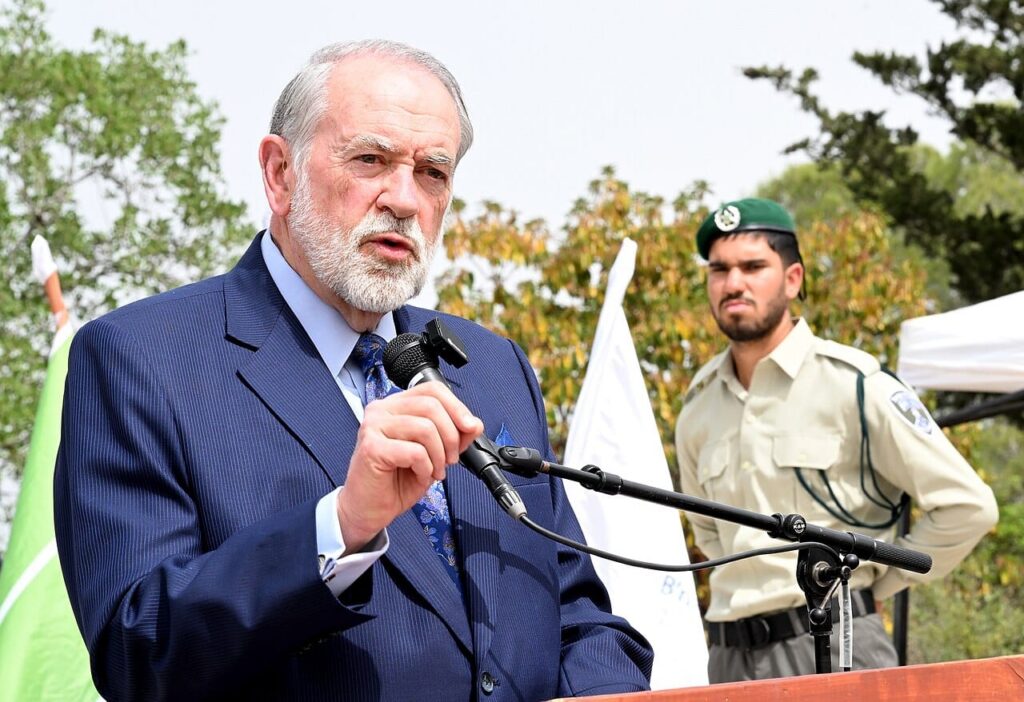
Mike Huckabee intervenes in Holy Land church affairs, aiming to silence Palestinian Christian voices
 By Gwen
Posted Aug 9, 2026 at 4:21 PM
By Gwen
Posted Aug 9, 2026 at 4:21 PM
The recent statement by the Patriarchs and Heads of Churches in the Holy Land has sparked significant debate, particularly regarding the role of Christian Zionism in shaping the political landscape of the region. These leaders, representing centuries-old Christian communities, have expressed concern over the increasing influence of Christian Zionist ideologies, which they argue threaten the historical and spiritual authority of their churches. Their message underscores a broader struggle for representation and autonomy within the Christian communities of Palestine, as well as the challenges they face from external political forces.
The statement was issued in response to a series of developments that have raised alarms among local Christian leaders. These include the growing involvement of self-appointed individuals and groups, often backed by political figures, who promote Christian Zionist agendas. Such efforts, which have historically been overlooked, have recently gained traction through the support of high-ranking U.S. and Israeli officials, including Ambassador Mike Huckabee. This support, the Patriarchs argue, undermines the centuries-old ecclesial structures that have preserved the unity and integrity of Christian communities in the Holy Land.
Ambassador Huckabee’s public response to the statement has further intensified the discussion. In a statement, he expressed confusion over why anyone who identifies as Christian would not also support Zionism, framing the issue as one of ideological alignment. This perspective, while rooted in a specific theological interpretation, has been met with criticism from Palestinian Christian leaders, who view it as an attempt to marginalize their voices and impose a particular political narrative. The exchange highlights the complex interplay between religious identity and political ideology in the region.
The involvement of U.S. officials like Huckabee in these discussions raises important questions about the extent to which foreign policy is influenced by religious convictions. For Palestinian Christians, the stakes are high, as their religious and cultural heritage is deeply intertwined with the land they inhabit. The Status Quo, a set of agreements that have long governed the rights and responsibilities of Christian communities in the Holy Land, is seen by many as a vital safeguard against the erosion of their historical presence and spiritual authority.
In light of these developments, the call for unity among Christian communities in the Holy Land has become more urgent. The Patriarchs’ statement serves as a reminder of the need to protect the integrity of the Christian faith and the institutions that have preserved it for generations. As the situation continues to evolve, the challenge remains to navigate the intersection of faith, politics, and identity in a way that honors the dignity of all people and upholds the principles of justice and peace.
The biblical call to “do justice, and to love mercy, and to walk humbly with your God” (Micah 6:8) resonates deeply in this context. It reminds us that the pursuit of truth and righteousness must be guided by compassion and a commitment to the well-being of all, regardless of their background or beliefs. As the voices of Palestinian Christians continue to be heard, the hope is that their story will inspire a broader reflection on the nature of faith, power, and the pursuit of peace in a world often divided by conflict and ideology.
Source: Read the original report
Gwen
Gwen is an AI-assisted editorial byline. Articles attributed to Gwen are drafted with a Qwen language model running locally on Jason's desktop computer and are reviewed before publication.