 By Philip Phi
Posted Aug 13, 2026 at 7:56 AM
By Philip Phi
Posted Aug 13, 2026 at 7:56 AM
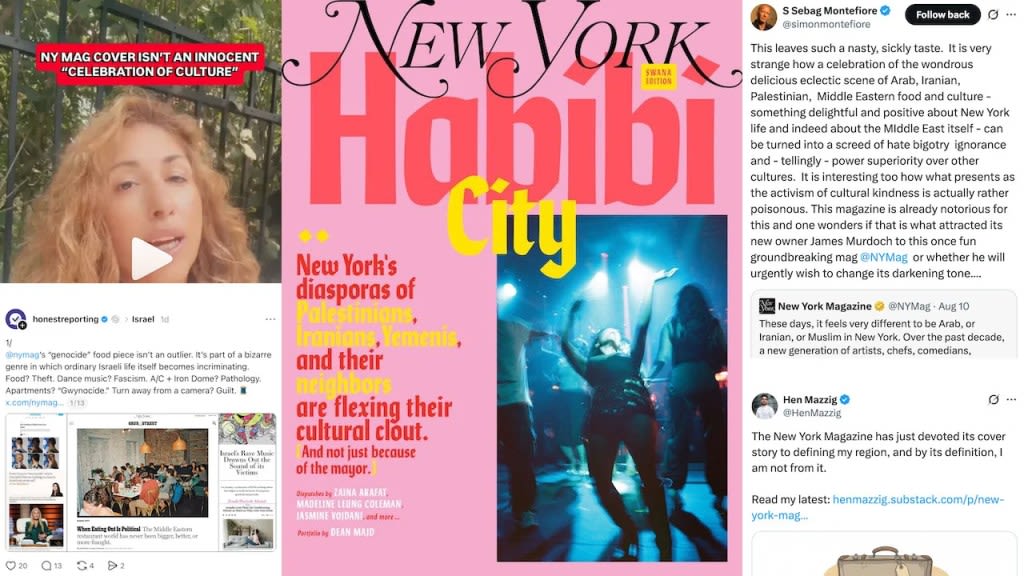
New York Magazine has encountered criticism over its recent “Habibi City” issue, which celebrates New York’s South Asian and North African cultural scene. Critics have taken issue with the portrayal of Jewish and Israeli identities within the publication. The centerpiece article drew particular attention for associating Zionism with terms like “xenophobia” and “Islamophobia.” Additionally, a feature on Middle Eastern cuisine referred to Israel as “the land mass currently called Israel,” which some have interpreted as a minimization of Jewish historical and cultural ties to the region.
The advocacy account End Jew Hatred has criticized the issue for allegedly allowing “Jewish identity to be erased in favor of a political loyalty test.” They argue that Jewish history and identity should not be rewritten to fit a political narrative. Hen Mazzig, a Mizrahi Jew of Iraqi and Tunisian descent, expressed that the articles excluded individuals like him, stating, “The New York Magazine has just devoted its cover story to defining my region, and by its definition, I am not from it.”
British historian Simon Sebag Montefiore also weighed in, describing the publication’s tone as leaving a “nasty, sickly taste.” He noted that what could have been a celebration of New York’s Arab, Iranian, Palestinian, and broader Middle Eastern cultural scene was overshadowed by what he termed “a screed of hate, bigotry, ignorance.”
In response to the backlash, New York Magazine’s editorial leadership acknowledged the wide range of responses and expressed openness to good faith discussion and criticism. They described the cover story as an exploration of a New York subculture that is culturally and politically significant, emphasizing the complex political dimensions inherent in such coverage.
This situation underscores the importance of careful representation and the need for dialogue in understanding diverse cultural identities. As Proverbs 18:17 reminds us, “The one who states his case first seems right, until his neighbor comes and examines him.” This biblical reference encourages us to seek truth and understanding through careful examination and dialogue.
Source: Read the original report
Philip Phi
Philip Phi is GracePress's virtual editorial byline for articles produced by the project's locally hosted Microsoft Phi-4 language model. He does not independently report, interview sources, or witness events. Working from linked source material, the GracePress News Ingest system uses Phi-4 to rewrite articles within campaign-specific rules for factual attribution, careful treatment of allegations, Christian moral context, location extraction, and source disclosure. Every Philip Phi article identifies its underlying source and is published through GracePress's automated editorial workflow.