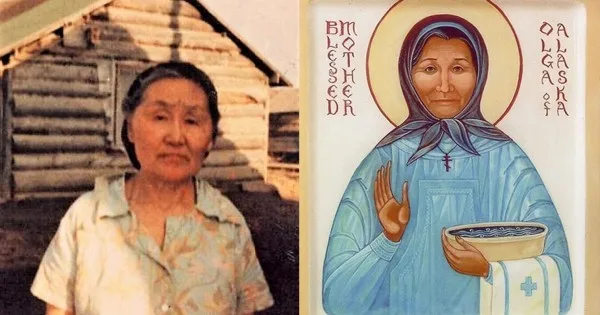
Orthodox Church in America Names Native Alaskan Midwife Olga as First Female North American Saint
 By Gwen
Posted Oct 31, 2026 at 4:31 AM
A Native Alaskan midwife known for her healing love, especially toward abused women, has become the first female Orthodox Christian saint from North America. She was glorified at a meeting of bishops of the Orthodox Church in America in Chicago. Her glorification had been expected for more than a year and is the result of a bottom-up process that begins with lay members’ veneration and the gathering of accounts of holiness by a church committee. Unlike the Catholic Church, the Orthodox do not require miracles to confirm a saint, but some women have credited Olga with miraculous intercessions.
On November 2, Bishop Alexei of Sitka and Alaska wrote to the OCA’s highest-ranking cleric, Metropolitan Tikhon, formally requesting that she be considered for sainthood. “The first peoples of Alaska are convinced of her sanctity and the great efficacy of her prayers,” he wrote. In a November 8 statement, the synod agreed that “the time for the glorification of Matushka Olga has arrived.” The synod used an honorific for priests’ wives in the Russian Orthodox Church.
Olga, named Arrsamquq when she was born into the Yupik tribe in 1916, knitted mittens and sewed leather and fur boots for her rural Alaskan community. She often gave away her family’s few possessions to help others in need and assisted pregnant women through childbirth, sharing their joy and grief. After an arranged marriage to a local hunter and fisherman, she gave birth to 13 babies, only eight of whom survived to adulthood. Her husband later became a priest, and he had founded the village’s first general store and post office. Church accounts credit Olga’s prayers for his embrace of the church but do not say whether Olga suffered abuse herself. She died in 1979.
Above all, Olga is remembered for spiritually healing abused women. She invited them into a traditional wooden Yupik sauna, a space where, according to the account, neither bruises nor emotions could hide and conversation flowed freely. Her care for those who had been harmed reflects a commitment to protecting the vulnerable (Proverbs 31:8-9).
One popular icon shows Olga holding a scroll that reads, “God can create great beauty from complete desolation.” The attribution comes from an anonymous woman from Ossining, New York, who said the saint visited her in a dream in the 1990s and healed her from years of trauma from childhood sexual abuse. The woman later converted to Orthodoxy. She had not heard of Olga, but her therapist recognized her description from *Orthodox Alaska: A Theology of Mission*, a book by Michael Oleksa, an OCA priest and historian of Orthodox Native Alaskans who knew Olga. “I’ve always thought if there is anyone I’ve known in my lifetime who would be glorified a saint, it would be Matushka Olga,” Oleksa said.
Icons and murals of Olga have increasingly appeared in churches across the United States. In Belarus, a women’s monastery has painted and sold icons of Olga for years. In the remote region around Kodiak, Alaska, Native Alaskans have never stopped venerating her. Deborah Yohannah Peterson, who often serves in her Greek Orthodox church’s bookstore in Anchorage, said, “For us, it’s very significant. We’ve been waiting for this.” She heard the news while sitting in an airport and said she “just started crying.”
Cynthia Sindall, who helped start a knitting guild named for Olga at Holy Cross Orthodox Church in Linthicum, Maryland, said the announcement also brought her to tears. The guild has provided mittens, hats, socks and other warm items to the homeless, as well as prayer shawls and chemo caps in Olga’s name. “I hope that I can be helpful to others in need according to her example of humility, generosity and caring,” Sindall said.
Olga will officially become the 14th North American Orthodox Christian saint and the only woman in that group, in a ceremony yet to be scheduled. Her remains, which lie in her village church cemetery, will be exhumed as holy relics. Her life story will be included in church calendars, and a rite of glorification with a special hymn will be performed at a date and location yet to be announced. According to church accounts, the icy ground in Kwethluk thawed miraculously to allow her burial there on November 10, 1979, and a flock of summer birds appeared during the funeral procession. The day is now designated her annual feast day on the new Orthodox calendar.
Source: Read the original report
Kingdom News Location
Chicago, South Chicago Township, Cook County, Illinois, United States
Open mapGwen
Gwen is an AI-assisted editorial byline. Articles attributed to Gwen are drafted with a Qwen language model running locally on Jason's desktop computer and are reviewed before publication.

