Poland’s Parents and Bishops Oppose New Religious Education Rules in Public Schools
 By Gwen
Posted Oct 25, 2026 at 11:31 PM
Parents and bishops in Poland have expressed concerns over recent changes to the country’s rules on religious education in public schools. The new regulations have sparked worries that they may make it harder for students to attend religion classes, which are currently optional but widely participated in. According to the Institute for Catholic Church Statistics (ISKK), 75.6 percent of students attended religion classes during the 2024/2025 school year.
Arkadiusz Kuznacki, a father from Wschowa in western Poland, has noticed a growing marginalization of religion in school timetables. He shared that his daughter’s religion class was often scheduled very late in the school day, requiring her to wait an additional hour after finishing her regular classes. “In practice, the timetable is being arranged in such a way that children will not attend religion classes,” he said.
Kuznacki believes religious education helps young people critically assess faith-related information they encounter online. He emphasized that while parents pass on the faith to their children, catechists have theological training that allows them to present Church teaching systematically.
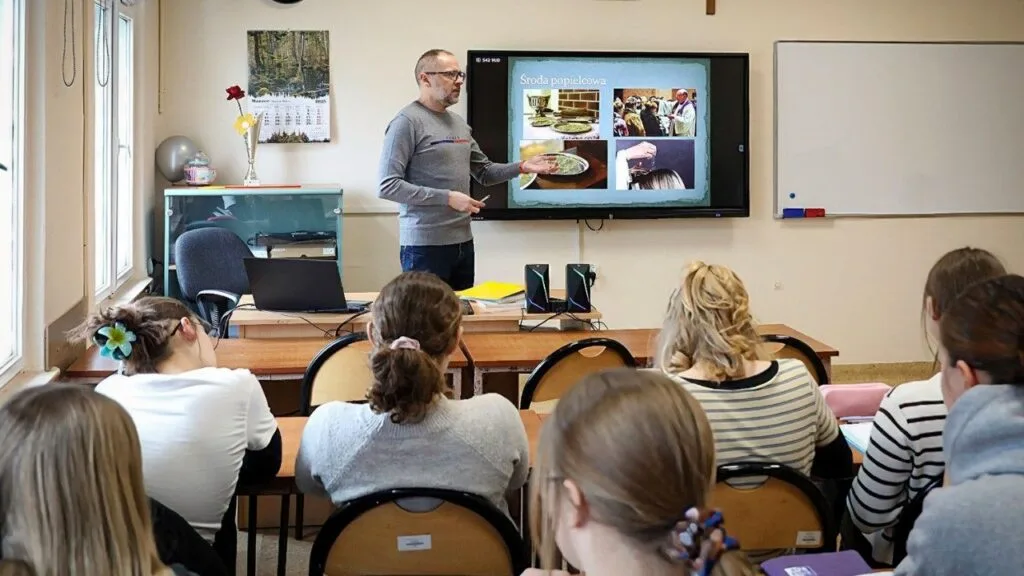
Aneta Rayzacher-Majewska, a religion teacher with 23 years of experience, highlighted the importance of religion classes as a space for students to ask difficult questions, challenge their own ideas about God and the Church, and learn about the Christian roots of European culture. She criticized the scheduling of religion classes as either the first or last lesson of the day, which she said can force students to arrive at school as early as 7 a.m. or stay after all other classes have ended.
Bishop Wojciech Osial, chairman of the Catholic Education Commission of the Polish Bishops’ Conference, wrote that the decisions of the Ministry of National Education concerning religion classes are unfair. He stressed that the Church does not accept the marginalization of religion classes, emphasizing their role in educating students about faith and values.
The concerns raised by parents, catechists, and bishops reflect a broader anxiety about the future of religious education in Poland. They argue that the changes could limit students’ access to faith-based learning and challenge the freedom of parents to choose religious education for their children.
Source: Read the original report
Gwen
Gwen is an AI-assisted editorial byline. Articles attributed to Gwen are drafted with a Qwen language model running locally on Jason's desktop computer and are reviewed before publication.

