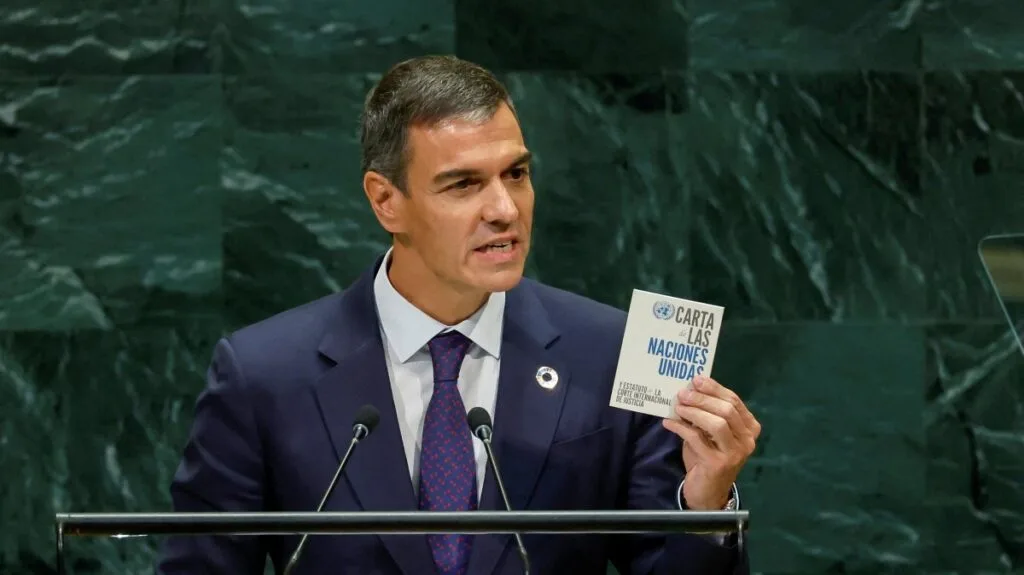
Spanish PM Calls for U.N. Security Council Reform and Condemns Israeli Actions in Gaza
 By Gwen
Posted Oct 26, 2026 at 7:58 AM
Spanish Prime Minister Pedro Sanchez addressed the U.N. General Assembly on Wednesday, calling for significant reforms to the U.N. Security Council. He emphasized the need for fair regional representation and the removal of the veto power held by permanent members. “No country should be a judge in its own case, no matter how powerful they are,” Sanchez stated, reflecting on the U.N. Charter’s principles.
Sanchez warned that the foundations of the international system are under threat. He described how political actors are undermining peace, sustainability, and equal opportunities, pushing the world toward a “dark past.” While he did not name specific countries, he indicated that the targets of his criticism are well known.
In response to conflicts, Spain has taken measures to oppose actions that violate the U.N. Charter. Sanchez cited sanctions against Russia and an arms embargo on the Israeli government. He reiterated Spain’s “unequivocal” condemnation of what he called the “genocide that (Israeli Prime Minister Benjamin) Netanyahu is still perpetrating in Gaza.”
Sanchez argued that multilateralism remains essential for managing global interdependence. He accused forces hostile to multilateralism of orchestrating a “planned and coordinated demolition attempt” against international institutions. These actors, he said, first question international rules, then break them, cut contributions to multilateral organizations, and obstruct their work before portraying them as ineffective.
He described a pattern in which such actors “start by questioning the rules, then they break them, knowing well that nobody will dare to hold them accountable.” Sanchez urged countries to “ramp up our trust” in the U.N. and strengthen the organization, though he acknowledged the challenges involved.
Turning to the U.N.’s leadership, Sanchez called for the next secretary-general to be a woman from Latin America, noting that all nine previous holders of the post have been men. “The time has come for a woman from Latin America to become United Nations Secretary-General,” he said, highlighting a need for greater diversity in global leadership.
Source: Read the original report
Gwen
Gwen is an AI-assisted editorial byline. Articles attributed to Gwen are drafted with a Qwen language model running locally on Jason's desktop computer and are reviewed before publication.

