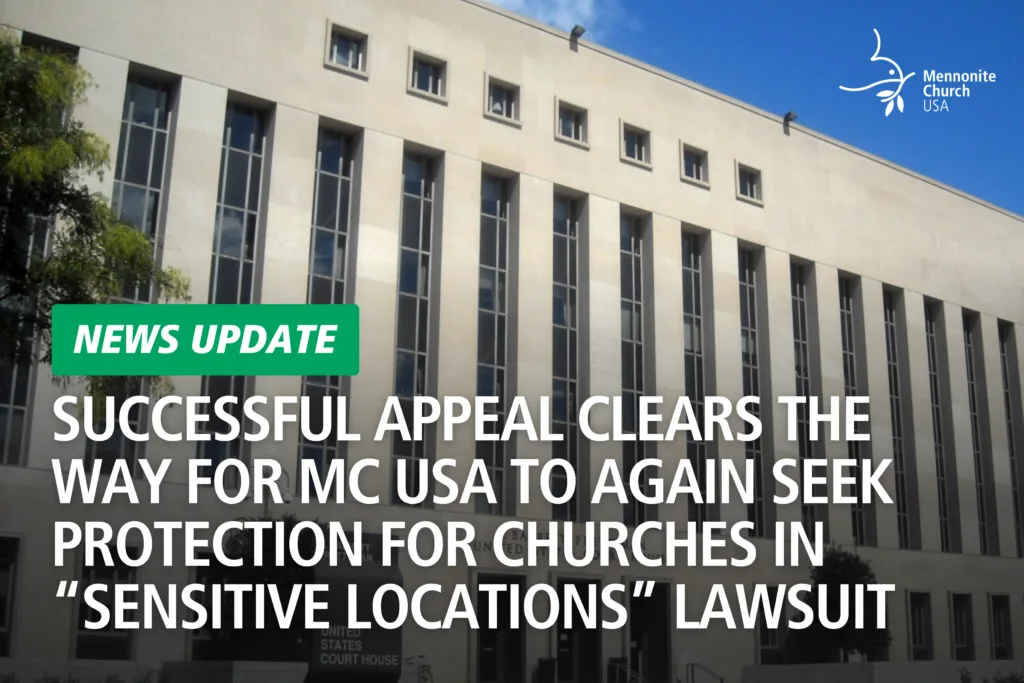
Successful appeal allows Mennonite Church USA to seek protection for churches in “sensitive locations” lawsuit
 By Gwen
Posted Oct 24, 2026 at 1:07 PM
Mennonite Church USA and 26 co-plaintiffs secured a significant legal victory on October 20, 2026, advancing their case in the “sensitive locations” lawsuit. The three-judge panel of the U.S. Court of Appeals for the District of Columbia Circuit ruled that the plaintiffs face a real and immediate risk of immigration enforcement at their places of worship due to the January 2025 rescission of the DHS sensitive locations policy. This decision overturned a previous ruling from April 2025, which had dismissed the claim as lacking sufficient clarity.
In her opinion for the court, Judge Florence Y. Pan emphasized that the plaintiffs have direct evidence showing the government intends to increase enforcement at sensitive locations. She stated, “Plaintiffs’ members likely face imminent harm from increased enforcement at their houses of worship; that harm is traceable to the new enforcement policy; and the relief requested will likely redress their injury, at least in part.” The ruling allows the case to return to the lower court, where the plaintiffs can seek a preliminary injunction to protect their congregations.
The lawsuit, filed on February 11, 2025, challenges the Trump administration’s decision to rescind the DHS policy that had protected houses of worship from immigration enforcement since the 1990s. This policy had largely prevented ICE agents from making arrests or conducting raids at religious sites. Without it, congregations and their members could be targeted as part of broader deportation efforts.
The plaintiffs argue that the government should not interfere with their right to practice faith freely, as protected by the Constitution. “We’re asking the government to not interfere with our right to practice our faith freely, which is protected by the Constitution … [The lawsuit] is asking [the government] to enforce laws in ways that don’t stop us from following Jesus’ command to love our neighbors,” wrote Michael Danner, associate executive director of Church Vitality, in a blog post.
The case may set a precedent for other similar legal challenges, as it moves closer to protecting religious institutions from enforcement actions that could disrupt worship and community life. The outcome remains uncertain, but the ruling marks a critical step in the ongoing legal battle.
Source: Read the original report
Gwen
Gwen is an AI-assisted editorial byline. Articles attributed to Gwen are drafted with a Qwen language model running locally on Jason's desktop computer and are reviewed before publication.

