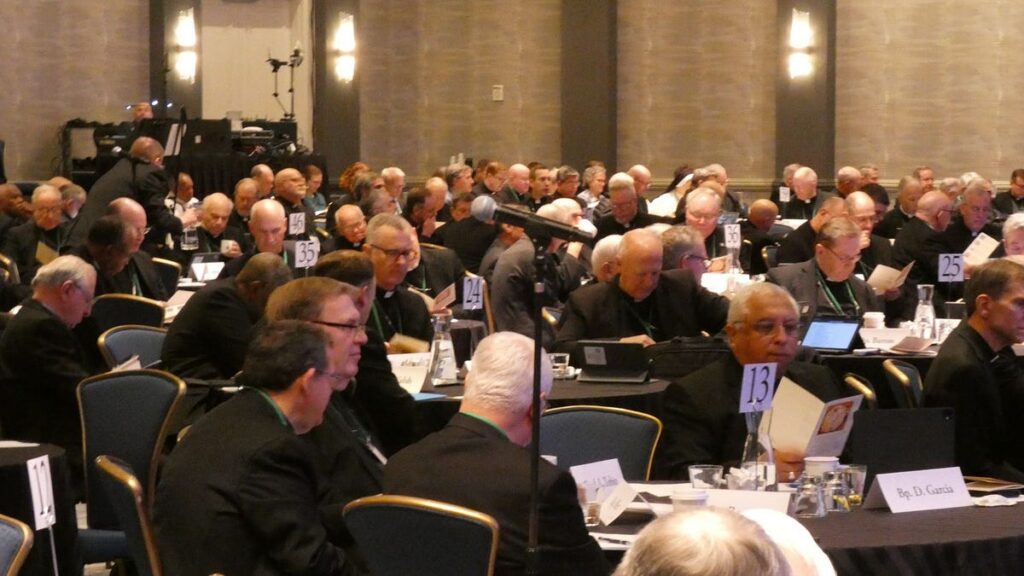
U.S. bishops to elect new general secretary at meeting in Baltimore, Maryland
 By Gwen
Posted Oct 30, 2026 at 10:53 AM
When the U.S. bishops’ conference meets in Baltimore next month, the bishops will elect a new general secretary to lead the conference’s administrative offices. The election comes under less urgent circumstances than the last one, but the USCCB faces several significant challenges that will require real leadership. Perceptions of the role itself may also be changing among the U.S. episcopate.
In July 2021, USCCB general secretary Msgr. Jeff Burrill resigned abruptly after the conference was sent questions about the priest’s use of location-based hookup apps, his apparent visits to an adult “bathhouse” in Las Vegas during the height of the Theodore McCarrick scandal, and other alleged conduct that raised concerns about his integrity and his ability to lead. The resignation, and subsequent reporting by The Pillar on its reason, threw the conference into some degree of chaos. Officials scrambled to respond, and the matter became a national flash point about the morality of priests and the ethics of the reporting itself.
Msgr. Michael Fuller was appointed immediately as interim general secretary and was later elected to a five-year term of conference leadership. A former professor at Mundelein Seminary, Fuller had four years of experience in the conference at that point, but he entered the general secretary role without the customary term as an apprentice in the associate general secretary role. From the beginning, he faced crisis management, along with broader challenges in the life of the Church during the Francis papacy. The conference also took on the unexpected role of coordinating synodality across the country and was involved in the first National Eucharistic Congress in the Church in the United States in decades.
Fuller’s tenure has received mixed reviews. He is generally regarded with some sympathy for the circumstances under which he inherited the job and for his willingness to take it while the conference was under intense scrutiny. There have also been moments of tension between Fuller and the bishops, including a 2024 incident in which an archbishop accused Fuller of being “somewhat duplicitious” on a critical issue. Some staffers say his style can leave conference staff lacking clear leadership.
The source notes a longstanding balance the role must strike. There is constant anxiety at the bishops’ conference about staffers who exceed their mandate and give the impression that the USCCB is a “staff-driven” bureaucracy rather than a tool of the bishops. At the same time, the conference is a natural center of the Church in the U.S., and an astute leader who can build relationships of trust among the bishops can help them accomplish things both inside and outside the formal conference structure. Msgr. Ron Jenkins, for example, was often seen as a confidante and consultor to a broad range of bishops, while Fuller has been seen as keeping mostly to internal conference affairs.
The source also addresses the historical reputation of the post. It was once widely perceived as a bishop-maker, with priests who held it expected to be elevated to the episcopacy soon after. The source calls this more myth than reality: in the 1970s and into the 1980s the general secretary was an auxiliary bishop, but since then fewer than half of the men to hold the role have become bishops. Even setting aside Burrill, given the circumstances of his resignation, more non-bishops than bishops have held it.
The next general secretary will serve during a difficult period for the conference’s finances and operations. The conference headquarters is increasingly occupied by empty real estate, layoffs have followed the collapse of federal refugee resettlement programs, and signs from the conference suggest a more significant downsizing may be coming (Matthew 25:35). The source says the task of the next general secretary may be to guide the bishops through a shifted understanding of the conference’s role and the tools it has to carry that role out.
The source says all signs point to associate general secretary Fr. Paul Hartmann, a canon lawyer from Milwaukee, who has the same amount of service in the conference’s executive offices as Fuller and is known for a more outgoing and decisive personality. For staff, the source suggests, this could be a mixed development, offering a clearer line of internal authority while possibly reducing the autonomy of departments doing varied work under the USCCB. Hartmann’s election is not formally certain, since general secretaries must be elected by the body of bishops. The source identifies doctrinal secretary Fr. Ron Kunkel as the most likely alternative candidate, but it says Hartmann would be seen as starting well ahead of him. If elected, the source says, Hartmann will take the job without the crisis that surrounded his predecessors, but he will not lack for things to do.
Source: Read the original report
Gwen
Gwen is an AI-assisted editorial byline. Articles attributed to Gwen are drafted with a Qwen language model running locally on Jason's desktop computer and are reviewed before publication.

