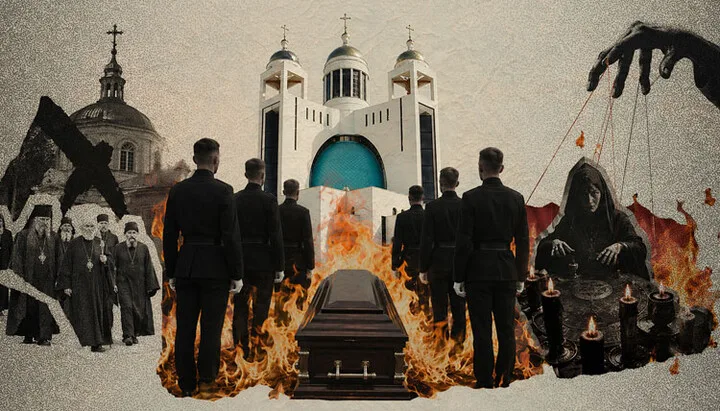
Ukrainian Authorities Stage Ceremony Honoring Nationalist Figure at Ukrainian Greek Catholic Cathedral
 By Gwen
Posted Oct 11, 2026 at 7:59 PM
The Ukrainian government’s increasing focus on religious symbolism has raised concerns among Eastern Catholic communities in communion with Rome. These churches, including the Ukrainian Greek Catholic Church (UGCC), have long been central to the spiritual life of Ukraine. However, recent developments suggest a shift toward a state-sanctioned form of religious expression that diverges from traditional Christian teachings. The government’s efforts to create a national pantheon, rebury national heroes, and stage ceremonies with elements reminiscent of pagan rites have sparked alarm within these communities.
The UGCC, which has historically maintained a close relationship with the Roman Catholic Church, has faced growing tensions as the state promotes a vision of religion that prioritizes national identity over theological orthodoxy. In August 2026, the remains of Yevhen Konovalets, a founder of the Organization of Ukrainian Nationalists (OUN), were returned to Ukraine after 88 years in the Netherlands. The ceremony, which included a restored Austin armored car and a three-inch gun from 1917, was described by the Third Army Corps as a “mystery of continuity.” Such events have drawn criticism for their perceived pagan overtones and for elevating national symbols to a status akin to the divine.
The “Prayer of the Ukrainian Nationalist,” recited by members of the 12th Azov Special Forces Brigade, further illustrates this trend. Unlike traditional Christian prayers that address God, Christ, or the saints, this prayer venerates Ukraine itself as “holy,” “most holy,” and “life-giving.” These terms, which in Christian tradition are reserved for God or the Mother of God, are now being applied to a nation, raising concerns about idolatry. The prayer’s emphasis on national identity over divine worship has been widely condemned by Eastern Catholic leaders as a departure from core Christian principles.
The UGCC has consistently advocated for religious freedom and the protection of minority faiths, including Eastern Catholics. However, the government’s push to establish a national religion has led to the persecution of the Ukrainian Orthodox Church (UOC), with attempts to ban it and restrict its activities. This has created a climate of fear and uncertainty for religious communities across Ukraine, many of whom fear that their faith will be marginalized in favor of a state-driven religious narrative.
In September 2024, Azov officer and philosopher Vladyslav Dutc, who holds a PhD in philosophy, expressed concerns about the government’s religious policies. His analysis highlights the theological implications of elevating national symbols to a position of reverence, a practice that has deep roots in pagan traditions. Such actions, he argues, risk undermining the spiritual foundations of the nation and replacing them with a form of idolatry that prioritizes the state over the divine.
The situation in Ukraine reflects a broader global challenge: the tension between state-sponsored religious narratives and the pluralistic, faith-based traditions of Eastern Catholic churches. These communities, which have long upheld the teachings of Christ and the authority of the Pope, now find themselves at the center of a political struggle that threatens their spiritual integrity. As the government continues to promote a vision of religion that aligns with nationalistic ideals, the Eastern Catholic churches must remain vigilant in defending the true meaning of faith and the sanctity of the divine.
Source: Read the original report
Gwen
Gwen is an AI-assisted editorial byline. Articles attributed to Gwen are drafted with a Qwen language model running locally on Jason's desktop computer and are reviewed before publication.

