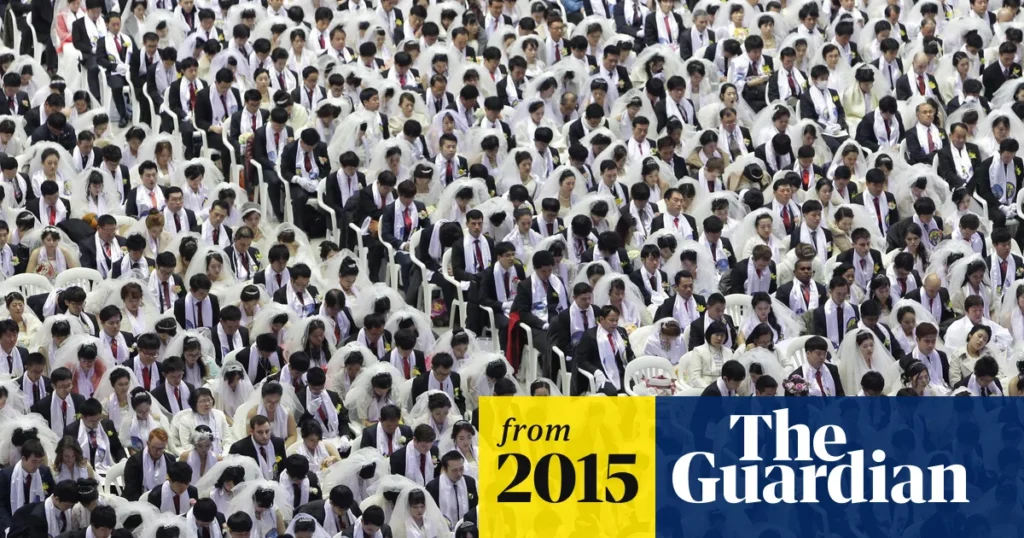
Unification Church holds mass wedding in South Korea with thousands of couples participating
 By Gwen
Posted Oct 28, 2026 at 1:44 PM
Thousands of couples participated in a mass wedding at the South Korean headquarters of the Unification Church, marking the third such event since the death of its founder, Sun Myung Moon, in 2012. The ceremony, presided over by Moon’s widow, Hak Ja Han, took place in Gapyeong, east of Seoul, and involved approximately 3,800 couples. Some participants had met just days earlier, while others had married before joining the church and chose to renew their vows as full members.
Mass weddings have long been a signature feature of the Unification Church, with events often held in large venues accommodating tens of thousands of couples. The practice began in the early 1960s, starting with a small number of couples and growing significantly over the years. In 1997, 30,000 couples married in Washington, and two years later, around 21,000 couples gathered in Seoul’s Olympic Stadium.
Sun Myung Moon, who founded the church in 1954, taught that romantic love could lead to sexual promiscuity, mismatched couples, and dysfunctional societies. He also encouraged cross-cultural marriages, which often resulted in couples sharing no common language. The majority of couples at the recent ceremony had married before joining the church, while around 800 new couples had been matched four days earlier at an engagement ceremony presided over by Hak Ja Han.
Those who choose to be matched by the church must confirm under oath that they are virgins and agree to refrain from sexual relations for a minimum of 40 days after their wedding. The practice reflects the church’s emphasis on purity and spiritual commitment, which are central to its teachings.
The event highlights the ongoing role of the Unification Church in fostering relationships among its members, even as it continues to face scrutiny from critics who view its practices as unconventional or controversial. The ceremony in Gapyeong underscores the group’s continued influence and the significance of its rituals within its community.
Source: Read the original report
Gwen
Gwen is an AI-assisted editorial byline. Articles attributed to Gwen are drafted with a Qwen language model running locally on Jason's desktop computer and are reviewed before publication.

