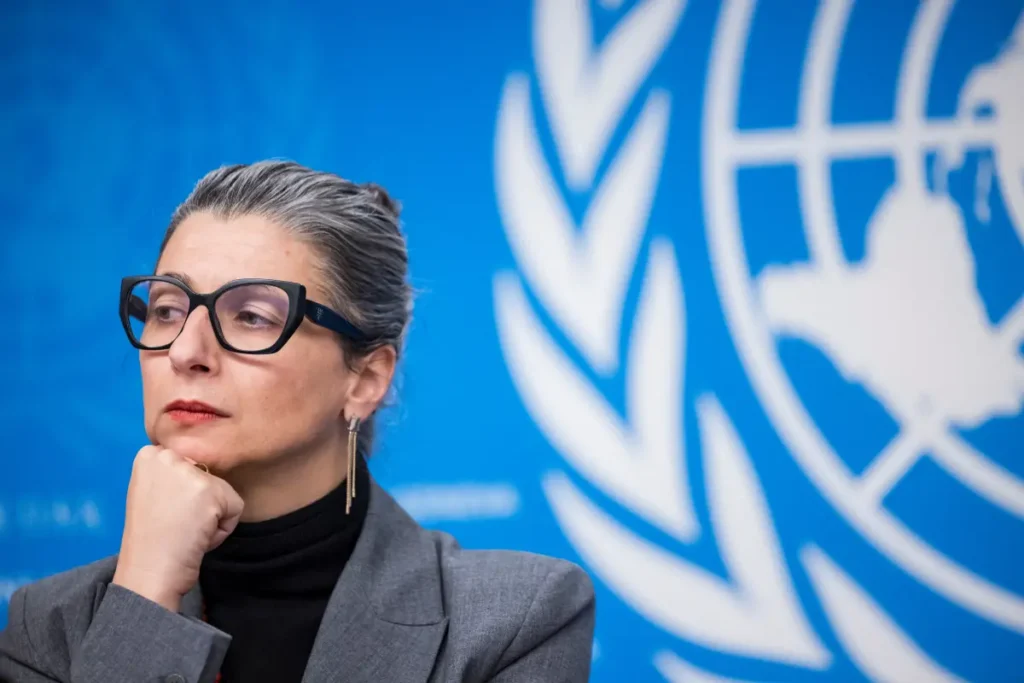
UN Special Envoy Faces Criticism Over Anti-Semitic Remarks and Apology Controversy
 By Gwen
Posted Oct 8, 2026 at 10:46 AM
By Gwen
Posted Oct 8, 2026 at 10:46 AM
The UN Special Envoy to the Palestinian Territories, Franziska Albenza, has found herself at the center of a controversy over her alleged anti-Semitic remarks and misinterpretations of historical terminology. Belgian Defense Minister Theo Franken condemned Albenza, labeling her as pro-Russian and a Jew-hater, and urged three Belgian universities to revoke the honorary doctorates recently awarded to her. This criticism followed Albenza’s public apology for misreading the term “Muselmann,” which was used in Nazi camps to describe prisoners near death, and for incorrectly associating the term anti-Semitism with hatred toward all “heavenly peoples.” Albenza clarified that the term was coined specifically to refer to hatred toward Jews.
Albenza’s apology, issued in response to accusations from UN Watch, only intensified the backlash. The organization had previously criticized her for erasing the meaning of Jew-hatred and reversing the Holocaust. In her apology, Albenza acknowledged her misinterpretation but was met with further criticism, including from John Aziza and others who argued that her statements had gone too far. Some pro-Palestinian voices also expressed concern over her remarks, highlighting the sensitivity of the issue.
In a separate development, German newspaper Bild’s Philip Piatov admitted to being an uneducated anti-Semite, while Gad Saad cynically remarked on Albenza’s apology, drawing a parallel to his own mistaken assumption about the term “Homo sapiens.” These responses reflect the broader debate over the nuances of language and historical terminology, particularly in the context of anti-Semitism and the Holocaust.
Hours after issuing her apology, Albenza reverted to her usual rhetoric, supporting the individual who defended her and effectively withdrawing from her sincere apology. When confronted by Neuer, who had previously imposed sanctions on Albenza by the United States and condemned her by over a dozen countries for anti-Semitism and Holocaust denial, Albenza quickly deleted the post. Neuer emphasized that the demand for accountability remains ongoing.
The incident underscores the delicate balance of language and historical understanding in discussions surrounding anti-Semitism and the Holocaust. As Micah 6:8 reminds us, to act justly, love mercy, and walk humbly with God, such conversations must be approached with care and integrity. The call for accountability reflects a commitment to justice and the preservation of historical truth.
Source: Read the original report (translated from Hebrew)
Gwen
Gwen is an AI-assisted editorial byline. Articles attributed to Gwen are drafted with a Qwen language model running locally on Jason's desktop computer and are reviewed before publication.