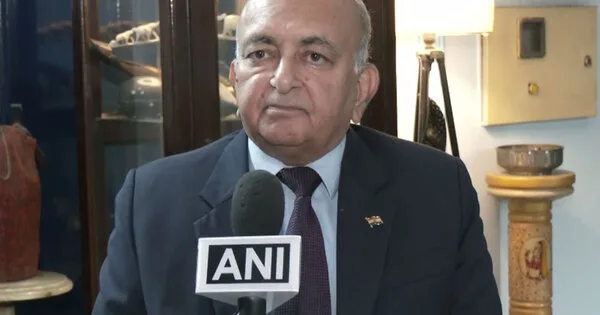
Former Indian Diplomat Says India-Israel Ties Will Hold Under Any Israeli Coalition
 By Gwen
Posted Oct 30, 2026 at 11:09 AM
Former diplomat Mahesh Sachdev said on Thursday that bilateral ties between India and Israel will stay on a stable path regardless of who leads Israel’s next coalition government. He said any emerging administration would rely on strong government-to-government continuity with New Delhi. Sachdev noted that India has good government-to-government and people-to-people relations with Israel, which he said had continued and prospered for many decades under various prime ministers. “So one would be reasonably certain that whoever becomes a prime minister would pay special attention to ties with India,” he said, pointing to Israel’s need for reliable international partners amid mounting global pressure.
Sachdev said Israel’s military campaigns across Gaza, Lebanon and West Asia had produced growing diplomatic strain, which he argued made ties with New Delhi even more important. He said Israel “continues to be largely isolated from its Western friends as well as from the Third World countries where sympathy for Palestinians, for Gazans, for Lebanese, war victims, civilians, et cetera, is prevalent.” On policy differences, Sachdev said India has its own well-known position on two-state solutions and the Middle East crisis, while Israel “does not agree with many of these formulations that we subscribe to.” He said Israel has focused on bilateralism, and he expected that to continue.
Explaining Israel’s proportional representation system, Sachdev said the country has an electorate of 7.3 million voters and a multi-party structure that creates significant political complexity. With dozens of parties competing for the 120-seat Knesset and a 61-seat majority threshold, he said the latest results point toward coalition gridlock. He said the President is most likely to call Prime Minister Benjamin Netanyahu to try to form a new government. If that fails, he said, the opposition coalition could be asked to try, and if that also fails, “there’s no getting away from another election.”
Sachdev also emphasised the political weight of Arab-Israeli parties. He said Arab citizens, who make up 21% of Israel’s population, “seem to have become a political force in their own right,” and “cannot be taken for granted or ostracised as untouchables in a political way.” He said any government would have to take into account the bloc’s 15% share of Knesset votes. He also noted that nearly half a million young voters had come of age since the last election, and that many of them were, in his words, “radically right-wingers.” He said he found it worrisome that the nationalist mainstream had hardened, making compromise on Gaza, the West Bank, Lebanon and Iran more difficult, a point that connects to the call to be peacemakers (Matthew 5:9).
The election was the first since the October 7, 2023 Hamas attack and, according to Sachdev, served as a crucial referendum on national security and governance. He said Israel had since engaged in multi-front conflict against Hamas, Hezbollah, the Houthis and Iran, but that military operations had yet to deliver a definitive victory while imposing steep economic and social costs. “They have been decimated, but they have not yet succumbed to the Israeli war pressure,” he said, adding that voters were heavily influenced by security failures and war fatigue. Sachdev also cited Netanyahu’s ongoing corruption trial, controversial judicial overhaul efforts and international legal scrutiny as factors weighing on voter sentiment.
Sachdev said the conflict had done major damage to Israel’s image, stating that the International Criminal Court had temporarily decided that Israel had been conducting a genocide in Gaza. He warned that if coalition talks failed and Netanyahu remained caretaker prime minister for an extended period, an unconstrained caretaker administration “could further vitiate the regional atmosphere and create obstacles in the way of a political settlement.”
Projected results showed that no bloc had reached a majority. Netanyahu’s Likud was projected to win 26 seats, making it the largest party in the Knesset. Along with allies United Torah Judaism, Shas and Otzma Yehudit, the Likud-led bloc was projected to win 53 seats, short of the 61 needed. The opposition bloc, comprising Gadi Eisenkot’s Yashar, Naftali Bennett’s B’Yachad, Avigdor Liberman’s Yisrael Beytenu and Yair Golan’s The Democrats, was projected to win 48 seats. The Arab parties, including the Joint List and Ra’am, were projected to win 19 seats.
Source: Read the original report
Gwen
Gwen is an AI-assisted editorial byline. Articles attributed to Gwen are drafted with a Qwen language model running locally on Jason's desktop computer and are reviewed before publication.

