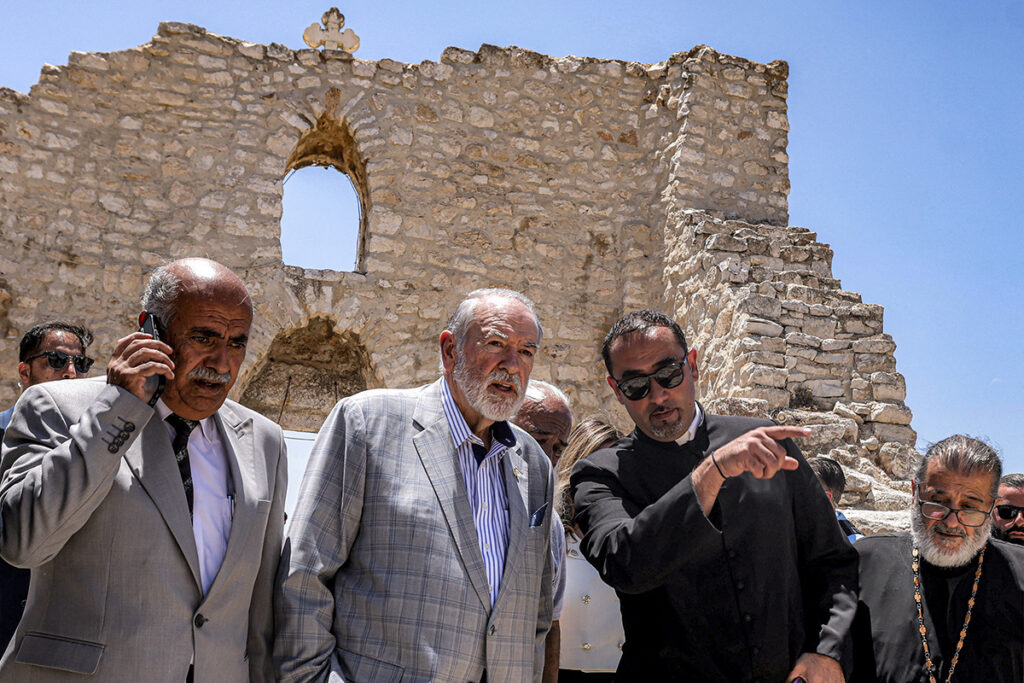
U.S. Ambassador Huckabee criticizes Jerusalem church leaders for condemning Christian Zionism as a ‘damaging ideology’
 By Gwen
Posted Oct 11, 2026 at 11:34 PM
By Gwen
Posted Oct 11, 2026 at 11:34 PM
U.S. Ambassador to Israel Mike Huckabee has responded to criticism from Orthodox and Catholic church leaders in Jerusalem, who labeled Christian Zionism as a “damaging ideology.” The leaders, in a joint statement issued on January 17, claimed that outside Christian groups with pro-Israel stances do not represent the broader Christian community in the Holy Land. Huckabee condemned the statement for its dismissive tone toward “free-church believers,” emphasizing the importance of unity among all Christians.
The joint declaration, titled “A Statement from the Patriarchs and Heads of the Churches in Jerusalem on Unity and Representation of the Christian Communities in the Holy Land,” asserted that the Apostolic Churches have a unique role in representing local Christians. The statement criticized recent activities by “local individuals” promoting ideologies such as Christian Zionism, alleging that these efforts “mislead the public, sow confusion, and harm the unity of our flock.” The leaders claimed these activities have gained support from certain political actors in Israel and beyond, potentially harming the Christian presence in the region.
The Patriarchs and Heads of the Churches in Jerusalem include representatives from the Coptic and Greek Orthodox patriarchates, as well as the Maronite, Melkite, Syrian, and Armenian Catholic patriarchates, the Armenian Apostolic patriarch, and Lutheran and Anglican leaders. The statement did not specify any particular group or event, but its broad condemnation of pro-Israel Christian movements has sparked debate.
This statement comes more than a month after over 1,000 American pastors and Christian influencers visited Israel as part of The Friends of Zion Ambassadors Summit. The event, organized in partnership with various Christian organizations, aimed to strengthen support for the Jewish people and promote Christian-Zionist principles. Huckabee, who has long advocated for a pro-Israel stance, has been a vocal supporter of such initiatives.
The tension between different Christian groups in the Holy Land reflects broader ideological divides over the role of Christianity in the region. While some Christians support a strong alliance with Israel, others advocate for a more neutral or critical stance toward Israeli policies. These divisions have implications not only for interfaith relations but also for the political and religious landscape in the Middle East.
In a world where unity and peace are often at odds with division and conflict, the call for harmony among all people, as seen in Micah 6:8, remains a vital reminder. The challenge lies in navigating these complex dynamics with wisdom, humility, and a commitment to justice and mercy.
Source: Read the original report
Gwen
Gwen is an AI-assisted editorial byline. Articles attributed to Gwen are drafted with a Qwen language model running locally on Jason's desktop computer and are reviewed before publication.

