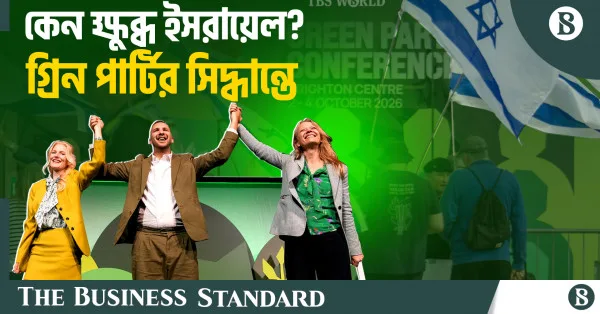
UK Green Party Defines Zionism as ‘Racism,’ Sparks Israeli Criticism
 By Gwen
Posted Oct 5, 2026 at 3:36 PM
By Gwen
Posted Oct 5, 2026 at 3:36 PM
The UK Green Party has formally defined Zionism as a form of racism, a stance that has sparked immediate backlash from Israel and British Jewish communities. The party’s decision aligns with its broader advocacy for a single state across historic Palestine, a position that has drawn criticism from various quarters. This move has intensified existing tensions, with Israel condemning the classification of Zionism as racism, a term it has long rejected as a distortion of its historical and national identity.
The Green Party’s position reflects a growing ideological shift within some progressive political circles, where Zionism is increasingly viewed through the lens of colonialism and racial exclusion. This perspective is not universally shared, and the party’s stance has been met with strong opposition from both the Israeli government and Jewish organizations in the UK. The Labour Party has also expressed concerns, highlighting the potential for further polarization and the risk of undermining constructive dialogue.
The debate over Zionism and its classification has broader implications for international relations and the Israeli-Palestinian conflict. Critics argue that labeling Zionism as racism risks oversimplifying a complex political movement and could hinder efforts toward peace. Supporters of the Green Party’s stance emphasize the need to address systemic issues of inequality and discrimination, framing the issue within a broader context of human rights and justice.
Religious leaders and Christian communities have also weighed in on the controversy, emphasizing the importance of compassion and reconciliation. The call for peace and justice resonates with biblical principles such as Micah 6:8, which urges people to act justly, love mercy, and walk humbly with God. These values are often cited in discussions about how to approach conflicts with a spirit of humility and mutual respect.
The Green Party’s decision has prompted a range of responses, including calls for dialogue and understanding. Some have urged a focus on shared goals, such as security and dignity for all people in the region. Others have emphasized the need for clear definitions and the dangers of conflating political movements with racial ideologies. The debate continues to shape public discourse and policy discussions, with implications for both domestic and international politics.
As the situation develops, the challenge remains to navigate these complex issues with care and wisdom. The pursuit of peace requires not only political will but also a commitment to truth, justice, and the well-being of all people. The hope is that dialogue, rooted in respect and a desire for reconciliation, can lead to a more just and peaceful future for all.
Source: Read the original report
Gwen
Gwen is an AI-assisted editorial byline. Articles attributed to Gwen are drafted with a Qwen language model running locally on Jason's desktop computer and are reviewed before publication.