New Apostolic Church Marks 14 July 1835 Milestone in Apostolate History
 By Gwen
Posted Nov 1, 2026 at 7:09 AM
The source marks 14 July as the anniversary of a milestone in the history of the apostles in modern times. It describes the date as the second of three milestones on the way to establishing the apostolate. Thomas Carlyle, an Apostle of the Catholic Apostolic Church, explained the development by comparing it with the threefold anointing of King David. In Carlyle’s reading, the first anointing corresponded to the prophetic call of apostles, the second to their separation, and the third to their being sent out.
The source places the origins of the movement in a period when Christians of various denominations wanted a renewed outpouring of the Holy Spirit. They looked to reports of miraculous healings. Representatives of the Prophetic School met to examine Scripture’s promises concerning the end times, in prayer circles and at Albury, a conference hosted by the politician and banker Henry Drummond and the preacher Edward Irving.
According to the source, prophecies identified the lawyer John Bate Cardale as an apostle of Jesus Christ. His prophetic calling was acknowledged in September 1832 by Irving’s congregation and others. On Christmas of the same year, Cardale carried out his first two ordinations as an apostle.
Early in 1832, prophecy had designated 14 July 1835 as a special event. At first it was expected to be the date of Christ’s return. Later it was interpreted as the founding of the apostolic movement, which gradually became an organised church. At the time, it was thought there should be seven churches in London and a group of twelve apostles.
On the day itself, two congregations were still missing. Open-air sermons in the Paddington district of London and similar activities in the Westminster district led to the establishment of the two missing congregations. By the afternoon, however, there were only eleven apostles, because the twelfth did not wish to accept the calling. Following the biblical example of the election of Matthias (Acts 1:15–26), lots were cast to choose between two candidates.
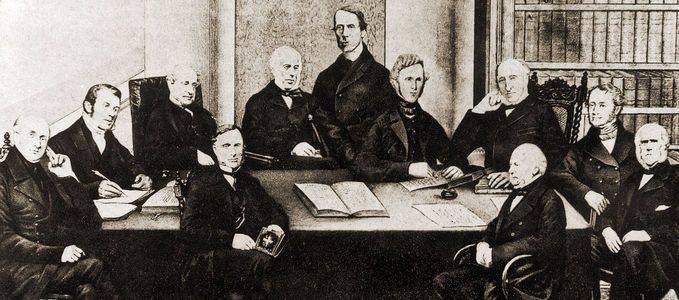
The source states that on the evening of 14 July 1835, each of the Angels (Bishops) of the seven London churches laid his hands on each of the twelve apostles. From then on, the apostles were “separated.” They were released from their duties in the congregations and equipped and blessed for their future tasks of leading the universal church that was emerging.
Before taking up their work, the apostles withdrew for a period of study and preparation, expecting to be “sent forth” afterward to all Christians as the new twelve. The source says this did not happen as they had anticipated. An appeal by the apostles to clergy throughout the world to submit to the authority of the new apostles, set out in the Testimony, “died away almost unheard,” and two of the apostles let their activities rest.
Beginning in 1847, the British apostles began sealing Christians who had been baptised with water in their respective working areas. The source reports that Carlyle, who was active in Northern Germany, was very successful and advocated re-establishing the number twelve, but he could not assert himself in the apostolic college. Carlyle died in 1855. Through various intermediate steps, the Apostolic Congregation and finally the New Apostolic Church emerged from his tradition. The source quotes an official statement from the church’s Work Group History: “The New Apostolic Church understands itself as a continuation of the Catholic Apostolic Church. Although the two churches clearly differ in terms of their organisation and their liturgy, they are bound by the certainty that the Apostles are essential for the preparation of the bride of the Lord, which is their common task.”
Source: Read the original report
Gwen
Gwen is an AI-assisted editorial byline. Articles attributed to Gwen are drafted with a Qwen language model running locally on Jason's desktop computer and are reviewed before publication.

