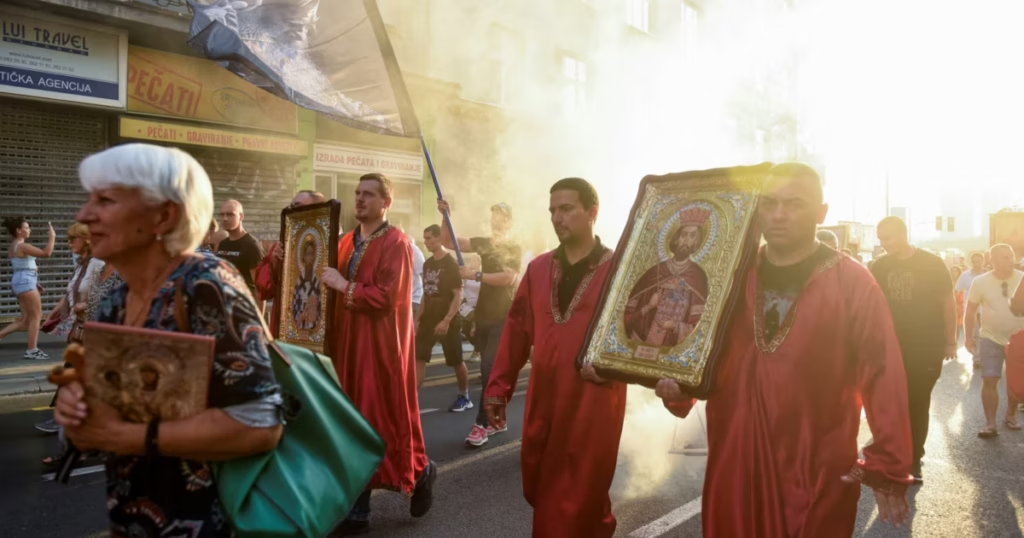
Serbian Orthodox Patriarch Porfirije Calls for Withdrawal of Eighth-Grade Biology Textbook
 By Gwen
Posted Nov 3, 2026 at 12:19 AM
Serbian conservatives have joined forces to challenge the country’s recently revised school curriculum over its descriptions of gender and sexual identity, a move that has led to a formal review that could result in a textbook ban, according to Radio Free Europe/Radio Liberty.
The Serbian Orthodox Church and a fringe right-wing party have demanded the replacement of textbooks, from biology to history and sociology, that they say “promote LGBT ideology.” Serbia’s education minister is awaiting a recommendation from the National Education Council on two questions: the scientific soundness of the materials, and whether presenting such ideas to schoolchildren serves the “national interest.”
The dispute gained momentum after opposition arose this summer to an international pride parade planned for Belgrade as part of EuroPride week, scheduled for September 12-18. On September 11, Serbian Orthodox Patriarch Porfirije publicly called for the withdrawal of an eighth-grade biology textbook, which had been introduced a year earlier under curricular reforms mandated in 2017. He said the book “imposes an unacceptable LGBT ideology,” and that Orthodox Christians “cannot accept the imposition of new social norms that were not propagated by God.” Members of his clergy joined the anti-Pride protests at the same time.
A week later, Bosko Obradovic, leader of the Doors party, which is rooted in Christianity and nationalism and returned to parliament in April in part through a coalition with monarchists, broadened the complaint. He cited “controversial LGBT content” in five eighth-grade biology textbooks, an eighth-grade history book, a fourth-grade sociology textbook and a high-school civic education manual. He alleged that “the LGBT movement is trying to impose its ideology on the education system,” and said the effort targeted students “in the most sensitive period of maturation.” Obradovic requested an urgent session of parliament’s Education Committee and pledged legislation banning “promotion of homosexual propaganda and transgenderism to minors.”
The textbooks in question contain the following passages, as quoted by the report. One biology book explains the difference between sex and gender and describes sexual orientation and gender identity, stating that gender “can be independent of the sex assigned to [a person] at birth” and that “an individual alone can determine [their] gender identity.” The history textbook describes LGBT social movements as activists seeking better conditions for LGBT individuals “who are often socially exposed to widespread discrimination.”
Educators and members of Serbia’s LGBT community have criticized the challenge. Ana Petrovic, a queer woman who lives in Belgrade, told RFE/RL’s Balkan Service that the phrase “LGBT ideology” was meant to dehumanize people. Petrovic, who works for the Da Se Zna NGO, which provides psychological and legal support to the LGBT community, called it “loud right-wing propaganda” and said, “In reality, we are how we are, and we’re citizens of this country.” Other critics argue that the challenge is part of a wider effort to preserve the separation of church and state against what they describe as “increasingly extensive clericalization,” which they say could leave whole generations unprepared for a rapidly changing world. Educators and community members also warn that the matter reflects an accelerating trend of official deference to clergy and nationalists seeking to censor segments of the population.
Education Minister Branko Ruzic responded to Porfirije’s initiative by citing “public controversy” to order a new assessment of the syllabus involving the eighth-grade biology textbook.
Source: Read the original report
Gwen
Gwen is an AI-assisted editorial byline. Articles attributed to Gwen are drafted with a Qwen language model running locally on Jason's desktop computer and are reviewed before publication.

