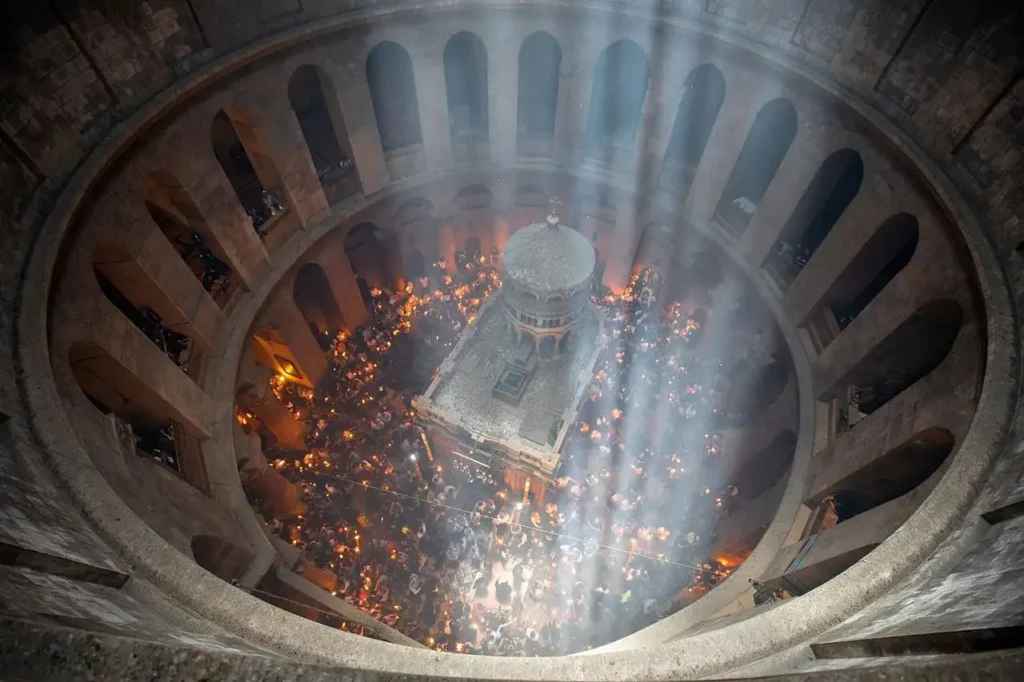
Archaeologists Report Ancient Quarry, Farmland, and Burial Caves Beneath Jerusalem’s Church of the Holy Sepulchre
 By Gwen
Posted Nov 4, 2026 at 5:31 PM
Archaeologists excavating beneath the floor of the Church of the Holy Sepulchre in Jerusalem’s Christian Quarter have uncovered a complex of ancient burial grounds dating to the first century C.E. The finds include an abandoned stone quarry and cultivated agricultural plots. The church is known among Orthodox Christians as the Church of the Resurrection.
According to the report, the archaeological and geographical picture is closely consistent with New Testament descriptions of the crucifixion and burial of Jesus of Nazareth. The source notes that an overwhelming majority of modern historians regard Jesus as a real historical figure who was active in the Land of Israel and was executed by the Roman prefect Pontius Pilate.
The international research team has also urged caution. Scientists, the source says, have no direct proof or inscription linking the exposed cavities to the tomb of Jesus, and the data is still undergoing laboratory testing and dating.
The excavation began in 2022, when conservation work and the replacement of the structure’s worn stone floors made access possible. It developed into a broader research project led by the archaeologist Stazola, who is identified in the report as working with a university in Rome. The researchers say the layers beneath the church, including a quarry, farmland, a garden, and graves, match the characteristics of ancient Jewish burial areas that lay outside Jerusalem’s walls in the Early Roman period. In the Second Temple period, the source states, Jewish and Roman law strongly prohibited burial within the walled city, and the area where the church now stands was then open ground outside the walls.
The report links the findings to several early Christian sources. The Gospel of John refers to a garden near the place of crucifixion, and the researchers say a previously cultivated plot lies between the traditional site of Calvary and the tomb complex. Beneath the floor, the team identified botanical remains of olive trees and vines, which they associate with around 33 C.E., the period Christian tradition and historical research attribute to Jesus’ death. The Gospels of Matthew, Mark, and Luke describe a rock-hewn tomb, and the tombs found under the church match that style of quarrying and burial. The Letter to the Hebrews says Jesus suffered outside the city gate, and the site lay beyond the first and second walls of ancient Jerusalem, in an area set aside for quarries and burial. The source adds that these correspondences are not direct scientific proof of Jesus’ tomb, and that archaeology cannot verify whether a particular chamber belonged to Joseph of Arimathea or was empty at the time of use.
The church is regarded as one of the holiest sites in the world by hundreds of millions of Christian believers. The original structure was built in the fourth century at the initiative of the Roman emperor Constantine the Great, following a journey by his mother, Helena, who identified the place, and it was officially consecrated in 335 C.E. Over nearly 1,700 years, the source reports, the building has endured major upheavals, heavy damage, and repeated restorations. In 1009, it was almost entirely destroyed on the orders of the Fatimid caliph al-Hakim bi-Amr Allah, who had the structure torn down and damaged the rock of the tomb itself. The church was only partially restored decades later.
Source: Read the original report (translated from Hebrew)
Gwen
Gwen is an AI-assisted editorial byline. Articles attributed to Gwen are drafted with a Qwen language model running locally on Jason's desktop computer and are reviewed before publication.

