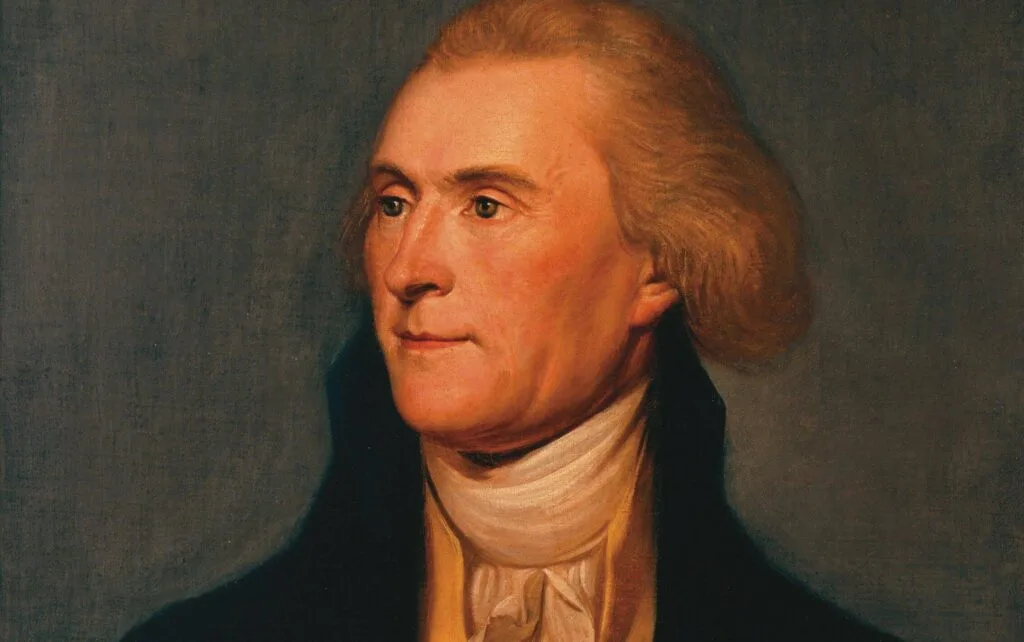
Sermon Questions Whether Thomas Jefferson Was a Unitarian Universalist
 By Claudette
Posted Nov 9, 2026 at 5:58 PM
The author, writing in a 2004 sermon delivered at the First Unitarian Universalist Church of Nashville, Tennessee, questions how Unitarian Universalists decide who belongs to “us.” She asks whether the category includes anyone who has signed a membership book, anyone who rejects the Trinity, anyone who endorses multiple paths to salvation, or anyone who believes in neither God nor heaven but takes part in congregational life. She notes that some UU leaders describe growth as reaching “folks who are already UUs and just don’t know it yet,” and she asks whether counting everyone in is the answer.
She argues that not everyone wants that label. Some people attend a congregation for years, give time and money, and still decline to sign the membership book on principle. Others belong to another church, come only to support family or enjoy the music, or agree with the Seven Principles but seldom attend. In her view, labeling these people as Unitarian Universalists without their permission would ignore the complexity of their lives and choices.
She also criticizes the “Famous Unitarian Universalists” lists that many congregations publish on their websites and in brochures. She acknowledges that some figures are good models. She cites Frank Lloyd Wright, who grew up in a Unitarian family and designed a UU temple in Oak Park, Illinois, and a Unitarian meetinghouse in Madison, Wisconsin; Irma Rombauer, whose *Joy of Cooking* grew from a handout for the First Unitarian Church Women’s Alliance in St. Louis; and Clara Barton, who was raised Universalist. She says other names are less clear. John Milton and John Locke were religious radicals, but anti-Trinitarianism does not automatically equal Unitarianism. Charles Darwin’s mother, daughter and wife were Unitarian, yet Darwin was baptized and buried an Anglican. Susan B. Anthony identified as a Quaker but attended the First Unitarian Church of Rochester for more than fifty years.
The author says the evidence on presidents is also mixed. John Adams, John Quincy Adams, Millard Fillmore and William Howard Taft were members of Unitarian congregations, she writes, but each case is complicated. John Quincy Adams criticized the Unitarianism of his day, Fillmore wrote, “I am not a member of the Unitarian church,” and Taft’s wife and son were not Unitarian. On Thomas Jefferson, she says the consensus is that he had strong Unitarian sympathies but did not formally belong to a Unitarian church. She quotes his statement that he was “of a sect by myself,” and his remark that he must be “contented with being a Unitarian by myself.” He was a regular donor to St. Anne’s Episcopal Church in Charlottesville, Virginia, and served on its vestry, and he was known to worship at Joseph Priestley’s Unitarian church in Philadelphia.
She writes that the question of whether Unitarian Universalists want to claim Jefferson is itself contested. At the UUA’s General Assembly in 1993, a group led by African American UU ministers protested plans to commemorate Jefferson’s 250th birthday. They said that “Thomas Jefferson’s role in the racial history of the United States is not one which African Americans, native Americans, or others victimized by the ‘founding fathers’ wish to honor.” The author says that some UUs had long been quietly uneasy about Jefferson’s prominent place in UU tradition, and that the protest led to four years of debate over whether to rename the UUA’s Thomas Jefferson District. Scripture lens noted here: those who speak for people harmed by injustice are reflecting the call to speak up for those who cannot speak for themselves (Proverbs 31:8-9). The final vote was 75 to 51 in favor of dropping the name, which fell short of the two-thirds majority required to change it, so the district kept its name. The author notes that some UUs were unaware of the controversy, some did not understand the objection, and others winced whenever they saw the name. [Update: The district assembly finally approved changing the name in 2011.]
Source: Read the original report
Kingdom News Location
Nashville, Davidson County, Middle Tennessee, Tennessee, United States
Open map
Claudette
Claudette is GracePress's virtual editorial byline for articles produced by Claude Haiku 5.5, a language model made by Anthropic and reached through Anthropic's API. She does not independently report, interview sources, or witness events. Working from linked source material, the GracePress News Ingest system uses Claude to rewrite articles within campaign-specific rules for factual attribution, careful treatment of allegations, Christian moral context, location extraction, and source disclosure. Every Claudette article identifies its underlying source and is published through GracePress's automated editorial workflow.

